You are now reading:
UOB Business Outlook Study 2026 (Thailand) H1: Businesses stay positive as costs rise and growth opportunities emerge

Find out how we can help you fast-track your investments in the JS-SEZ.
Learn more
you are in UOB ASEAN Insights


You are now reading:
UOB Business Outlook Study 2026 (Thailand) H1: Businesses stay positive as costs rise and growth opportunities emerge
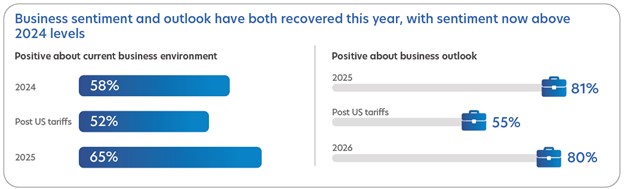
A positive outlook continues to lift Thai Small and Medium Enterprises (SMEs). According to the UOB Business Outlook Study 2026 (Thailand) H1: over three in five Thai businesses are confident about their prospects and expect business conditions to improve in the short term.
However, this rising business confidence is tempered by the lingering effects of the 2023 economic slowdown. Rising tariff-related costs and weather disruptions continue to weigh on SMEs in the short term; geopolitical uncertainty, rising costs, and an urgent demand for transformation remain the foremost long-term challenges facing these businesses.
Against this complex backdrop, businesses are reassessing priorities and adapting their strategies accordingly. The UOB Business Outlook Study 2026 reveals that:
For the first time in the Business Outlook Study’s seven-year history, UOB will conduct the study twice a year to better keep pace with fast-moving economic and geopolitical conditions.
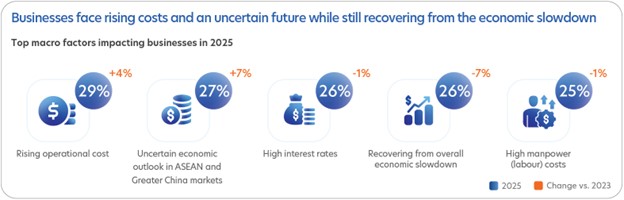
Businesses in Thailand are striking a balance between confidence and caution. Business sentiment may have rebounded following the easing of United States (US) tariffs—but rising operating costs, high interest rates, and economic uncertainty still complicate the operating environment.
The pressure is most acute in sectors with high operating expenses and complex supply chains, including manufacturing, construction and consumer goods.
More than half of Thai businesses have seen their supply chains affected by recent geopolitical events. In response, many of these businesses are foregoing aggressive capital expenditure in new domestic markets, choosing instead to fortify domestic positions and manage their fiscal health.
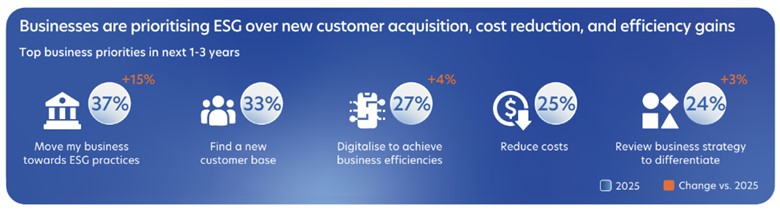
In the face of these pressures, businesses are looking beyond short-term cost-cutting and investing in long-term competitiveness. Over the next one to three years, ESG (37 per cent), customer acquisition (33 per cent) and digitalisation (27 per cent) rank ahead of cost reduction (25 per cent) on respondents’ business priorities.
That said, the slowdown caused by global trade pressures may soon give way to meaningful growth momentum between 2027 and 2028.
Thai businesses are seeking transformation support in 2026, alongside solutions that enhance operational efficiency and provide greater flexibility in managing tax obligations. Notably, businesses in the Professional & Business Services sector continue to prioritise transformation despite being relatively unscathed by US tariffs, highlighting a broader focus on long-term preparedness.
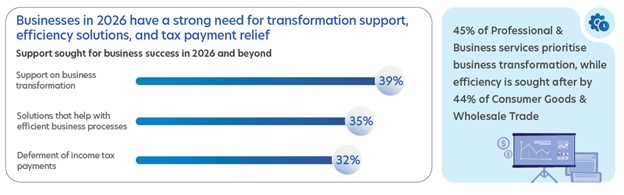
Growth opportunities also remain front of mind. As the government advances its ESG agenda, businesses are looking for incentives to accelerate sustainability adoption and offset implementation costs. At the same time, support for overseas expansion and export development is seen as critical for broadening customer demand and unlocking new avenues for growth.
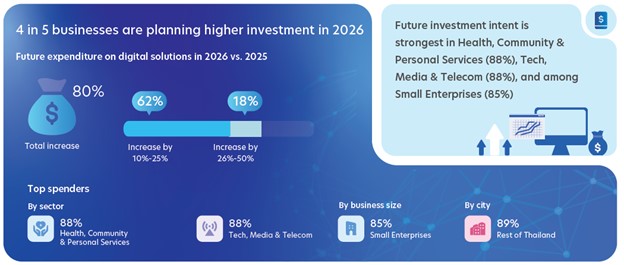
Thai businesses have built considerable momentum in digital adoption, with four out of every five businesses implementing it in at least one department. The trend points to sustained investment in digital infrastructure, helping businesses manage operational expense (OpEx) pressures as higher interest rates increase the cost of capital.
Similarly, four out of five Thai businesses plan to increase digitalisation investments in 2026 for a variety of other reasons: to increase customer outreach (38 per cent), improve productivity (37 per cent), and to scale up overall business performance (32 per cent).
Thailand has emerged as one of the region's frontrunners in artificial intelligence (AI) adoption, with 71% of businesses already deploying AI in their operations. This figure is significantly higher than the regional average and suggests that technology investment has moved from experiment to operating necessity.
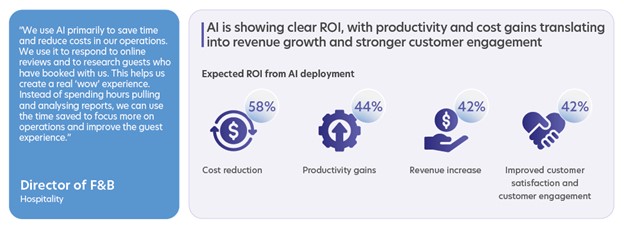
Thai businesses that have adopted AI report seeing tangible returns: 58 per cent report immediate savings from AI-driven process automation while 44 per cent have achieved meaningful productivity gains via AI integration.
Yet scaling AI remains easier said than done. Talent shortages and data readiness issues continue to limit implementation, while the current high-interest-rate environment has increased the cost of funding transformation initiatives.
For many Thai firms, AI adoption is a foregone conclusion, but many have yet to establish a sustainable path to large-scale deployment.
As of H1 2026, sustainability has become firmly embedded in the strategic priorities of Thai businesses, with many recognising it as essential to long-term growth and business continuity.
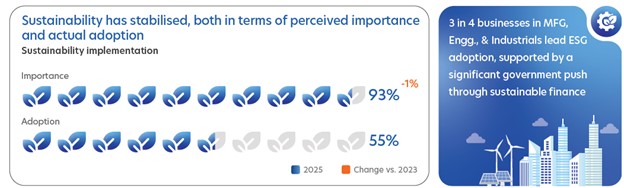
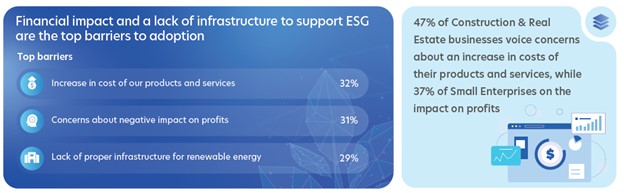
Yet a gap remains between intent and action. While 93% of businesses consider ESG critical to their future success—among the highest levels in the region–only one in two businesses have translated that commitment into concrete sustainability initiatives.
This implementation gap is driven by three primary barriers:
As sustainability expectations rise across international markets, Thai businesses increasingly see ESG as the cost of doing business within global supply chains.
This is most evident in energy management, now a top priority for 94 per cent of businesses. Strategic investments in this department are concentrated o in practical efficiency measures, led by solar panel installation (45 per cent), LED lighting upgrades (34 per cent), and AI-based optimisation tools (32 per cent).
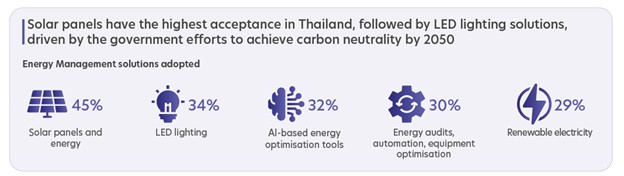
These investments are driven as much by economics as sustainability goals. In an environment of rising capital costs, reducing energy consumption offers a way to manage operating expenses and enhance business resilience. However, many firms still face significant barriers to adoption, including high upfront costs (42 per cent) and a lack of expertise (37 per cent) in employing energy management solutions.
Geopolitical supply chain disruptions appear to be easing, with 55 per cent of businesses reporting a return to 2024 conditions—approaching pre-US tariff baseline levels.
Thai SMEs are using this reprieve to strengthen their supply chain strategy. Over nine in 10 Thai SMEs surveyed now prioritise supply chain management. Among them, 78 per cent plan to diversify suppliers, while 66 per cent are looking to expand manufacturing within ASEAN.
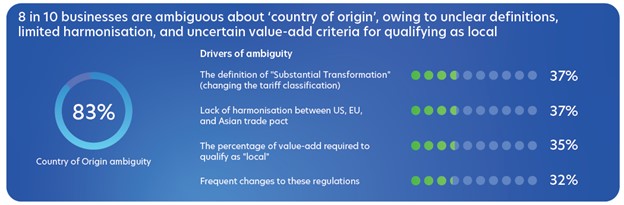
However, stability remains elusive: over half of Thai businesses still experience the effects of regional volatility, while over eight in 10 businesses experience uncertainty around local content and country-of-origin regulations that complicate supply chain planning.
Thai businesses increasingly view supplier diversification (28 per cent), digitalisation (26 per cent), and e-commerce adoption (26 per cent) as critical levers for improving supply chain resilience.
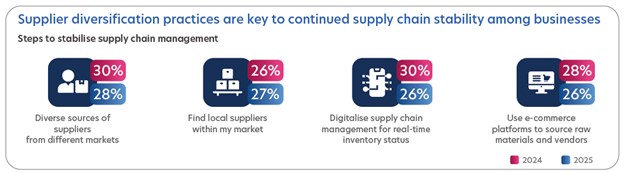
Diversification is top of mind for many Thai businesses, of which two out of every three respondents report an intention to set up new manufacturing bases in 2026. These expansionary instincts are motivated generally by the need to access new markets (69 per cent) and the desire to optimise costs (58 per cent).
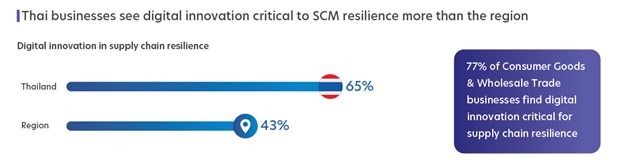
Digital innovation is now considered essential to supply chain resilience by 65 per cent of Thai businesses. The figure rises to 77 per cent in the Consumer Goods & Wholesale Trade sector, reflecting the industry's reliance on digital technologies to navigate evolving supply chain regulations.
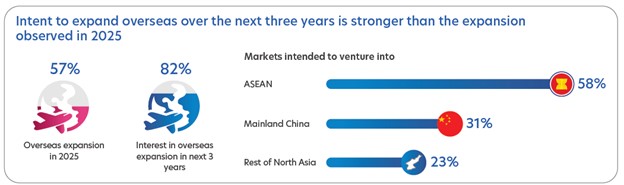
In H1 2026, Thai businesses are increasingly pursuing overseas expansion as both a growth strategy and a risk-management tool. Four in five businesses express interest in expanding internationally over the next three years, building on 2025’s baseline where three in five had already established an overseas presence.
Although revenue growth remains the primary driver for expansion (cited by 55 per cent of respondents), two out of every five respondents cite risk diversification as their primary motive: performing geographic arbitrage to help hedge against localised disruptions and domestic economic cooling.
Many businesses also report constraints to international growth—facing talent shortages (34 per cent) and difficulties scaling operations efficiently (35 per cent) key among them.
ASEAN remains the preferred destination for expansion-minded Thai entrepreneurs. Singapore (60 per cent), Vietnam (58 per cent), and Malaysia (46 per cent) are the most sought-after markets, reflecting a balance of geographic proximity and deep ASEAN-based economic integration.
Foreign direct investment (FDI) is expected to play a central role in these expansion plans. Businesses are implementing FDI not only to access new markets, but also to reduce supply chain vulnerabilities and take advantage of favorable regulatory and tax regimes.
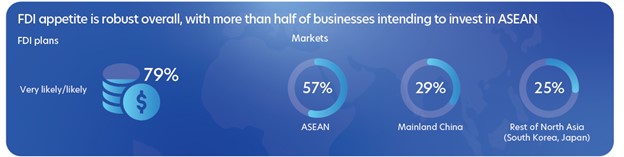
Nearly 80 per cent of businesses intend to make significant capital investments over the next two years, with seven in ten planning deployments of between US$1 million and US$25 million. More than half (57 per cent) of this capital is earmarked for investment in fellow ASEAN countries.
The outlook among Thai businesses remains remarkably resilient. From the UOB Business Outlook Study 2026, we’ve learned that businesses are investing in the capabilities they believe will drive long-term success: digital transformation, AI, sustainable operations, stronger supply chains, and regional expansion.
The challenge now lies in execution. As financing costs stay high and global conditions continue to evolve, Thai businesses will need to allocate capital carefully while maintaining the agility required to respond to new risks and opportunities.
Drawing on deep regional connectivity and decades of experience supporting businesses across ASEAN, UOB is committed to helping Thai enterprises strengthen resilience, capture new opportunities and achieve sustainable growth. Contact us to find out more.

The UOB Business Outlook Study 2026 (Thailand) H1 surveyed 265 business owners and senior executives from Small and Medium Enterprises in Thailand. Conducted online in January 2026 the study offers insights into:
The H1 2026 edition also introduces three new Pulse Topics, offering deeper insights into emerging business priorities:
This article shall not be copied or relied upon by any person for whatever purpose. This article is given on a general basis without obligation and is strictly for information only. The information contained in this article is based on certain assumptions, information and conditions available as at the date of the article and may be subject to change at any time without notice. You should consult your own professional advisers about the issues discussed in this article. Nothing in this article constitutes accounting, legal, regulatory, tax or other advice. This article is not intended as an offer, recommendation, solicitation, or advice to purchase or sell any investment product, securities or instruments. Although reasonable care has been taken to ensure the accuracy and objectivity of the information contained in this article, UOB and its employees make no representation or warranty, whether express or implied, as to its accuracy, completeness and objectivity and accept no responsibility or liability for any error, inaccuracy, omission or any consequence or any loss or damage howsoever suffered by any person arising from any reliance on the views expressed and the information in this article.
Get the UOB Business Outlook Study 2026 (Thailand) H1.Download now