You are now reading:
ASEAN Consumer Sentiment Study 2025 (Regional): Optimism rises despite cost-of-living crunch
Discover how their spending and financial habits are changing with insights from UOB’s consumer confidence barometer.

Find out how we can help you fast-track your investments in the JS-SEZ.
Learn moreyou are in UOB ASEAN Insights


You are now reading:
ASEAN Consumer Sentiment Study 2025 (Regional): Optimism rises despite cost-of-living crunch
The ASEAN economy has displayed resilient growth amid global economic uncertainty. UOB projects ASEAN’s real GDP growth to stabilise at around 4.6 per cent, driven by foreign direct investment, robust trading and greater collaboration among member-states. While the region is currently facing some economic uncertainty, it appears well-positioned to navigate global headwinds that is reflected in our latest consumer sentiment report.
For the past six years, UOB has been tracking consumer sentiments across Singapore, Malaysia, Thailand, Indonesia, and Vietnam through our flagship UOB ASEAN Consumer Sentiment Study (ACSS). This year’s survey was conducted from May to June and captures the responses of 5,000 consumers across demographic groups in ASEAN.
Highlights from UOB’s ACSS 2025 report include:
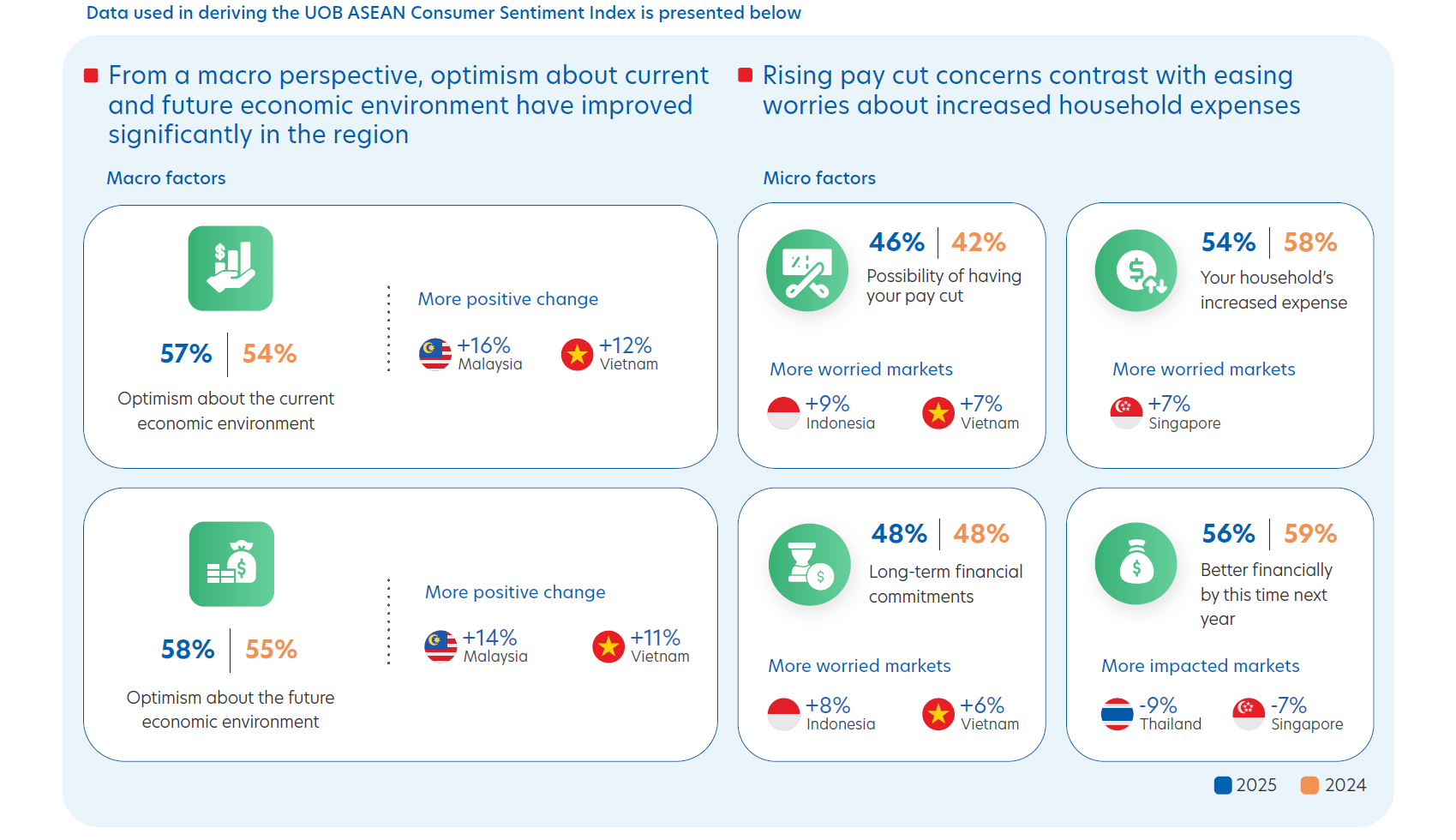
From a macro perspective, more consumers in ASEAN are optimistic about the current (57 per cent) and future (58 per cent) economic environment – each increasing 3 percentage points compared with last year.
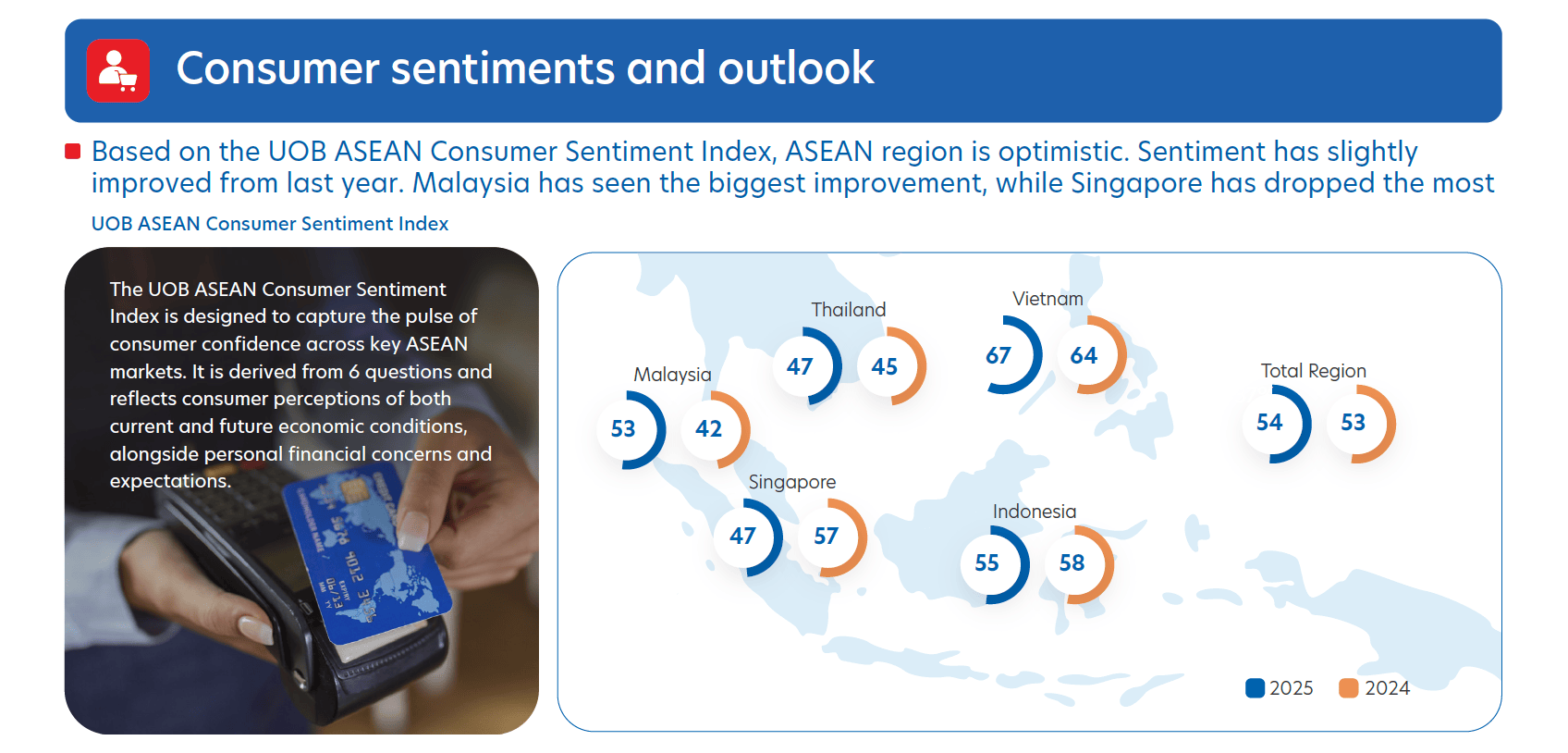
Overall, the region’s Consumer Sentiment Index score rose slightly to 54 per cent. Malaysia displayed the most improvement, jumping 11 percentage points to 53 per cent. But south of its border, Singapore paints a different picture. It is among the most worried markets in ASEAN, with consumer optimism dropping by 10 percentage points to 47 per cent. The number of consumers worried about their household’s increased expenses rose by 7 percentage points, while the number of consumers who believe they will be better off financially by this time next year decreased by 7 percentage points.
More than half of ASEAN consumers believe that their country’s economic (60 per cent), political (57 per cent), and social environment (61 per cent) is stable – a notable exception being Thailand, where military clashes along the Thailand-Cambodia border have raised local tensions.

Figure 1: Feelings about current economic, political and social stability
Increased cost of living due to inflation is still the top concern regionally, though it has declined by 3 percentage points from last year. The majority (56 per cent) believe that inflation will erode their purchasing power, with a smaller proportion planning major spending cutbacks.
Fewer consumers are cutting back on non-essential spending or actively seeking discounts. However, Singapore is the outlier: more consumers there are intensifying these cost‑saving behaviours, with increases of 8 and 14 percentage points respectively.
When asked how their shopping habits have changed, consumers across the region said they are still seeking deals, buying carefully, choosing local goods and buying through social media platforms.

Figure 2: How consumers’ shopping habits have changed
Almost two in five people (38 per cent) increased their spending in the experiential and luxury category compared with last year. In fact, 71 per cent of consumers — especially those younger — say experiential expenditure is “essential”. Key markets that value spending on experience are Vietnam (80 per cent) and Indonesia (76 per cent).

Figure 3: Close to 40 per cent of consumers spent more in the ‘Experiential and Luxury’ category versus a year ago
While expenses have increased, some consumers remain prudent, allocating more of their budgets to savings, insurance, and payments towards loans, mortgages, and rent.
Cash is still the dominant payment method. The majority (60 per cent) made cash payments in the last year, with 95 per cent of cash users paying in cash at least once a week. Among consumers in Singapore, cash is the preferred payment method during overseas trips. Meanwhile, Malaysians see cash as a backup in case of card failure.

Figure 4: Mobile payments and cash are the top payment methods used by ASEAN consumers
But digital payment methods are quickly becoming the norm, with 59 per cent and 53 per cent of respondents making e-wallet and scan-to-pay payments in the last year, respectively. Convenience (66 per cent) is the key reason for the popularity of e-wallets, followed by not needing to carry cash (51 per cent), and being easy to top up (49 per cent).
Despite financial strains caused by inflation, 88 per cent of consumers feel confident about managing their finances, with confidence levels higher in Indonesia (94 per cent) and Vietnam (94 per cent).

Figure 5: Consumers in Indonesia and Vietnam show the highest confidence in managing their finances
Three in four consumers save more than 10 per cent of their monthly personal income, with Vietnamese consumers saving the most (82 per cent). Most respondents (86 per cent) have an emergency fund, with 58 per cent of them able to cover three to six months of regular expenses. In terms of investments, the number of people who invested more than 10 per cent of their annual income fell – particularly in Vietnam and Singapore (-13 and -12 percentage points respectively).
At UOB, we help businesses navigate the dynamic landscape of the ASEAN region to unlock their full potential. Contact us to find out about our tailored solutions, industry knowledge, and market expertise.
The ASEAN Consumer Sentiment Study (ACSS) is UOB’s regional flagship study analysing consumer trends and sentiments in five countries: Singapore, Malaysia, Thailand, Indonesia and Vietnam. Now in its sixth year, the survey was conducted from May to June 2025 and captures the responses of 5,000 consumers across different demographic groups in the region.
Some of the areas covered include:
This article shall not be copied or relied upon by any person for whatever purpose. This article is given on a general basis without obligation and is strictly for information only. The information contained in this article is based on certain assumptions, information and conditions available as at the date of the article and may be subject to change at any time without notice. You should consult your own professional advisers about the issues discussed in this article. Nothing in this article constitutes accounting, legal, regulatory, tax or other advice. This article is not intended as an offer, recommendation, solicitation, or advice to purchase or sell any investment product, securities or instruments. Although reasonable care has been taken to ensure the accuracy and objectivity of the information contained in this article, UOB and its employees make no representation or warranty, whether express or implied, as to its accuracy, completeness and objectivity and accept no responsibility or liability for any error, inaccuracy, omission or any consequence or any loss or damage howsoever suffered by any person arising from any reliance on the views expressed and the information in this article.

09 Dec 2025 • 5 mins read

20 Nov 2025 • 5 MINS READ

06 Nov 2025 • 5 MINS READ

01 Sep 2025 • 5 MINS READ
Get the ACSS 2025 (Regional) infographics. Download now