You are now reading:
UOB Business Outlook Study 2026 (Indonesia) H1: Businesses strengthen resilience and efficiency amid rising global uncertainty

Find out how we can help you fast-track your investments in the JS-SEZ.
Learn more
you are in UOB ASEAN Insights


You are now reading:
UOB Business Outlook Study 2026 (Indonesia) H1: Businesses strengthen resilience and efficiency amid rising global uncertainty
Businesses in Indonesia are navigating a more complex operating environment shaped by rising costs, geopolitical tensions, and evolving trade dynamics. While nine in 10 report a positive outlook in 2026, companies continue to pursue growth opportunities, focus on strengthening resilience, improving operational efficiency, and managing risks.
Rising operating costs, the impact of the United States (US) tariffs, and ongoing geopolitical developments are key factors affecting business conditions. This mirrors broader trends across ASEAN, where companies are adapting to cost pressures, global energy volatility, and shifting trade dynamics.
Against this backdrop, businesses in Indonesia are taking a more measured approach. While overall sentiment has improved compared to earlier periods of disruption (43 to 93 percentage points), companies are prioritising supply chain resilience, diversification, and operational optimisation to navigate uncertainty
Many Indonesian businesses are advancing digitalisation and risk management initiatives to face business volatility, enhance efficiency, and better position themselves for sustainable, long-term growth.
Amid ongoing macroeconomic uncertainty, the UOB Business Outlook Study 2026 reveals that:
Digital adoption among Indonesian businesses is nearly universal, with close to nine in 10 having adopted a digital solution in at least one department. Businesses that have adopted digital solutions are feeling the gains, with 50 per cent reporting improved business performance, 44 per cent reporting increased productivity, and 44 per cent reporting enhanced customer outreach.
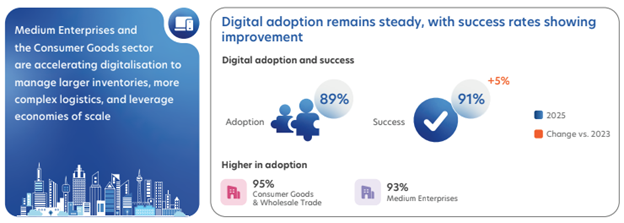
Confidence in digitalisation’s return on investment (ROI) remains high. Over nine in 10 plans on increasing digital spending in 2026, with a significant proportion planning increases of 26 to 50 per cent. At the same time, concerns around cybersecurity risks, data privacy, and implementation costs remain key considerations.
Artificial intelligence (AI) is also gaining traction. Three in four businesses have implemented AI solutions, although maturity levels vary, with half at early stages and one-quarter at advanced stages of adoption.
AI adoption is strongest in Tech, Media & Telecom, Consumer Goods & Wholesale Trade, and Medium Enterprises – sectors supported by deeper digital maturity. This suggests that digital maturity is a prerequisite for the success of AI implementation. Among companies that have fully digitalised their operations, 39 per cent have reached advanced AI stages, significantly higher than the overall sample average of 26 per cent.
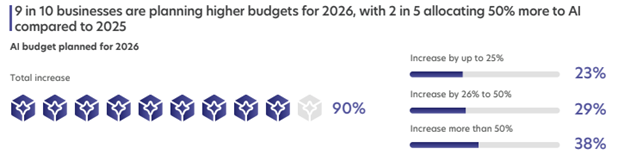
Businesses that have adopted AI reported seeing tangible gains in productivity (50 per cent), revenue growth (48 per cent), and improved customer satisfaction (47 per cent). Nine in 10 plan to increase AI budgets in 2026, with two in five planning increases of more than 50 per cent driven by AI’s proven ROI.
While businesses express optimism about AI, key barriers to adoption persist. This includes data and system readiness issues, financial constraints, talent and capability gaps, particularly among Small Enterprises.
Sustainability has consistently ranked as a top priority among Indonesian businesses, with 97 per cent viewing it as important in 2025. This sentiment is most prominent among Medium Enterprises, where 99 per cent view it as critical. Around half of all businesses have already implemented sustainability initiatives, with adoption gradually increasing over the years. The top incorporated sustainable practices include implementing clear operational policies and processes (52 per cent), using energy-efficient equipment and technologies (50 per cent), and more efficient use of resources to minimise waste (44 per cent).
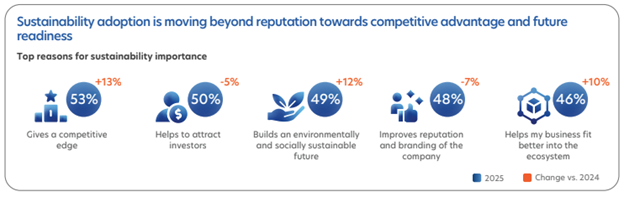
Beyond brand reputation, the key drivers of sustainability adoption include competitiveness, investor appeal, and long-term resilience. Indonesia’s net-zero targets and the climate changes impacting the country’s coastlines may also be driving sustainability as a top priority among businesses.
However, challenges remain. Businesses are concerned about profit impact, higher upfront costs, and a lack of renewable energy infrastructure when it comes to sustainability adoption.
A similar trend is observed in energy management, with 96 per cent of businesses viewing it as important. This is particularly relevant for Medium Enterprises with higher energy demands.
Some of the key focus areas for energy management are optimising energy usage via digital tools (44 per cent), reducing energy consumption (44 per cent), and ensuring stable energy supply (43 per cent). In that same vein, the most adopted solutions include Energy Management System (EMS) – adopted by two in five businesses to counter rising electricity and fuel prices – efficient machinery, and AI-based energy optimisation tools.
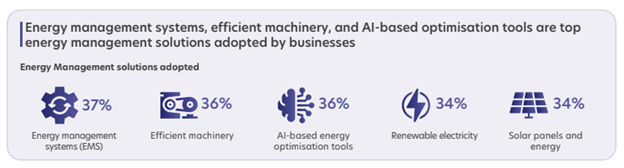
High upfront investment costs (42 per cent) and limited internal expertise (34 per cent) remain the main barriers to wider adoption.
Supply chain management is a critical concern across sectors and business sizes. While disruptions eased at the time of the survey (January 2026), around seven in 10 businesses still reported ongoing challenges—higher than in 2024.
Regulatory ambiguity around “Local Content” and “Country of Origin” requirements affects nine in 10 businesses, complicating long-term planning.
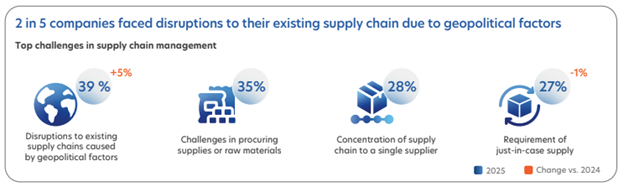
To mitigate risks, businesses are strengthening diversification strategies, including multi-country sourcing (43 per cent) and reducing dependence on single suppliers (42 per cent). More than eight in 10 plan to expand supplier networks in 2026, primarily within Indonesia and across ASEAN.
“Near-shoring” within ASEAN is particularly prominent among Consumer Goods & Wholesale Trade businesses (95 per cent), while seven in 10 companies are considering establishing manufacturing facilities locally or within the region.
Beyond resilience, supply chain strategies are also driven by market expansion (66 per cent) and cost optimisation (65 per cent).
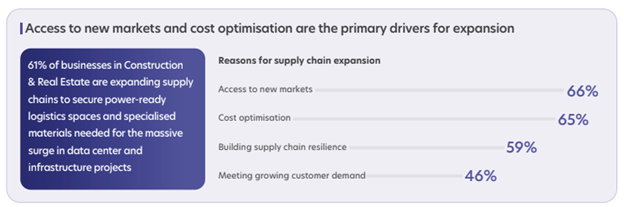
While supply chain management is top on the board agenda for Indonesian businesses, high costs (cited by 63 per cent of organisations) are the main constraint for developing a resilient supply chain, especially in the Tech, Media & Telecom sector. Meanwhile, 46 per cent struggle with supplier reliability when moving into new markets.
Indonesian businesses carried over expansion momentum from 2024 into 2025, with more than nine in 10 interested in expanding over the next three years. Expansion is increasingly seen as both a growth strategy and a means of diversifying risks following US tariff developments.
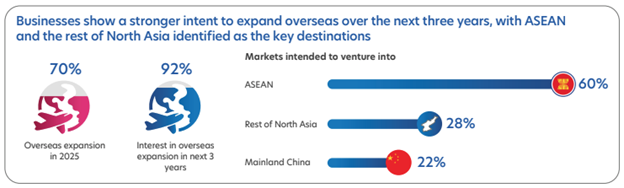
ASEAN and North Asia are key destinations for expansion due to the region’s rapidly growing middle class and ease of trade provided by the ASEAN Economic Community. Businesses in Health, Community & Personal Services, for example, are looking to tap ASEAN and North Asia’s ageing population and leverage cross-border digital health standards for telehealth and clinical informatics. Within ASEAN, Thailand and Vietnam are top destinations for future expansion in the near future.
Key drivers include profitability (51 per cent), revenue growth (47 per cent), brand positioning (44 per cent), and manufacturing expansion (40 per cent).
However, given the region’s fragmented nature, finding trustworthy local partners who understand foreign market regulations is critical in overseas expansion. The shortage of such talents is the top hindrance to expansion plans, especially in Construction & Real Estate and Consumer Goods & Wholesale Trade. This is followed by the logistical complexities of scaling operations across borders (35 per cent) and a lack of in-house talent or expertise to lead international teams (35 per cent).
More than eight in 10 businesses plan to invest overseas, with 60 per cent targeting the high-growth ASEAN corridor, underpinned by China-Plus-One strategies. This trend is most prominent among businesses within Professional Services and Consumer Goods & Wholesale Trade, which are investing in ASEAN as a diversification strategy to de-risk their global footprints.
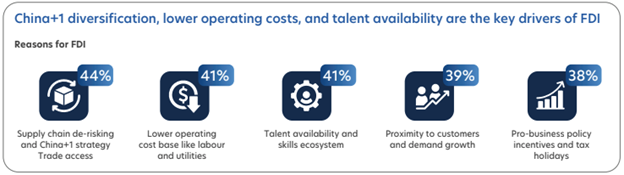
ASEAN is also a favourable region for investment, as it is a neutral manufacturing hub with beneficial trade access. The region’s web of Free Trade Agreements (FTAs) is an alluring proposition for many businesses, as they lower the costs of moving goods and services across borders.
Two in five businesses intend to invest between USD 5 million and USD 25 million in their overseas ventures, led by businesses in the Manufacturing, Engineering & Industrials sector.
Despite a challenging business environment, Indonesian businesses remain positive about the business landscape in the next few years. However, they are not going slack. Many businesses are digitalising their operations, adopting sustainability measures, and diversifying their supply chains in an effort to increase operational efficiency and resilience, and face continual global disruptions head-on.
“Businesses today are operating in an environment shaped by heightened geopolitical uncertainty, evolving regulations, and changing trade flows. As companies adapt to these developments, we are seeing greater emphasis on supply chain resilience, operational visibility, liquidity management, and digitalisation. Businesses are becoming more selective in their investments, focusing on initiatives that improve efficiency, strengthen risk management, and support long-term competitiveness.
At UOB Indonesia, we continue to support our clients with integrated trade, cash, and supply chain solutions, including digital platforms such as UOB Infinity, which help businesses manage payments, liquidity, and cross-border operations more efficiently while navigating an increasingly complex business environment.”
– Mr W Kartyono, Transaction Banking and Channels Solutions Director, UOB Indonesia
With UOB’s regional expertise – covering tailored financial solutions, sustainable financing, and cross-border trade support – we can help Indonesian businesses navigate an increasingly complicated environment, while opening doors to further growth and success. Contact us to find out more.

The UOB Business Outlook Study 2026 (Indonesia) H1 surveyed 272 business owners and senior executives from Small and Medium Enterprises. Conducted online in January 2026, the study offers insights into:
The H1 2026 edition also introduces three new Pulse Topics, offering deeper insights into emerging business priorities:
This article shall not be copied or relied upon by any person for whatever purpose. This article is given on a general basis without obligation and is strictly for information only. The information contained in this article is based on certain assumptions, information and conditions available as at the date of the article and may be subject to change at any time without notice. You should consult your own professional advisers about the issues discussed in this article. Nothing in this article constitutes accounting, legal, regulatory, tax or other advice. This article is not intended as an offer, recommendation, solicitation, or advice to purchase or sell any investment product, securities or instruments. Although reasonable care has been taken to ensure the accuracy and objectivity of the information contained in this article, UOB and its employees make no representation or warranty, whether express or implied, as to its accuracy, completeness and objectivity and accept no responsibility or liability for any error, inaccuracy, omission or any consequence or any loss or damage howsoever suffered by any person arising from any reliance on the views expressed and the information in this article.
Get the UOB Business Outlook Study 2026 (Indonesia) H1.Download now