You are now reading:
UOB Business Outlook Study 2026 (Malaysia) H1: Diversification and digital innovation set companies apart

Find out how we can help you fast-track your investments in the JS-SEZ.
Learn more
you are in UOB ASEAN Insights


You are now reading:
UOB Business Outlook Study 2026 (Malaysia) H1: Diversification and digital innovation set companies apart
Malaysia’s business landscape is building resilience in the face of uncertainty. As cost pressures and tariff tensions rise, enterprises are rapidly adapting to emerging risks.
This resilience is reflected in the country’s gross domestic product (GDP) growth of 5.3 per cent in the first quarter of 2026. While lower than expected, this growth performs well above the government’s full-year forecast of 4 to 4.5 per cent and the predicted GDP of most major Asian economies.
Amidst elevated global oil and energy prices, Malaysia remains well-placed to weather the storm thanks to its abundant natural gas reserves. And as worldwide demand for semiconductors continues to accelerate, its semiconductor industry has carved out a strong niche in backend chip processing, strengthening the nation’s innovation-led growth.
This positive outlook is echoed in the UOB Business Outlook Study 2026. Business sentiment has rebounded since the impact of United States (US) tariff hikes in 2025, with seven in 10 Malaysian enterprises now feeling positive about the current business environment. While the global landscape remains fluid, local companies are repositioning for growth by accelerating AI adoption, improving energy efficiency, and reinforcing supply chain resilience.
Amid ongoing macroeconomic uncertainty, the UOB Business Outlook Study 2026 reveals that:
Inflation continues to be a key challenge for companies in Malaysia. Manpower costs, rising operating expenses, and high interest rates have impacted nearly three in 10 businesses. To manage increased expenses, one in three companies is embarking on cost-cutting measures.
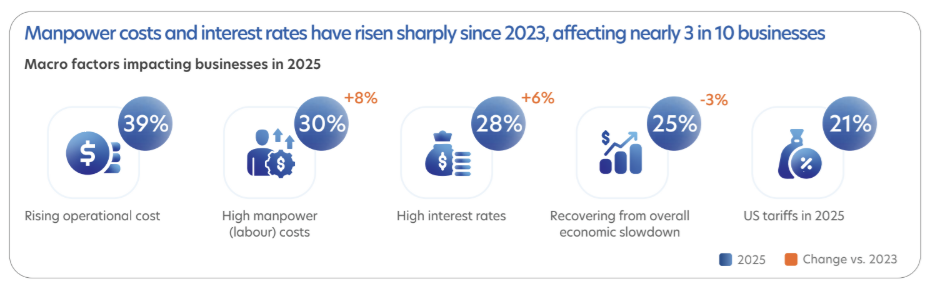
Despite these macroeconomic challenges, eight in 10 firms improved their revenue performance in 2025 – an encouraging sign of business resilience.
Businesses remain optimistic for the year ahead. Over three-fourths (77 per cent) of companies expect their performance to improve in 2026 as compared to 2025. However, this positive sentiment is more muted among small enterprises, which are still recovering from the overall economic slowdown.
To overcome hurdles to growth, businesses are seeking greater support to enhance capabilities. In 2026, companies will need more business transformation support, workforce upskilling, and efficiency-driven solutions to maximise productivity.
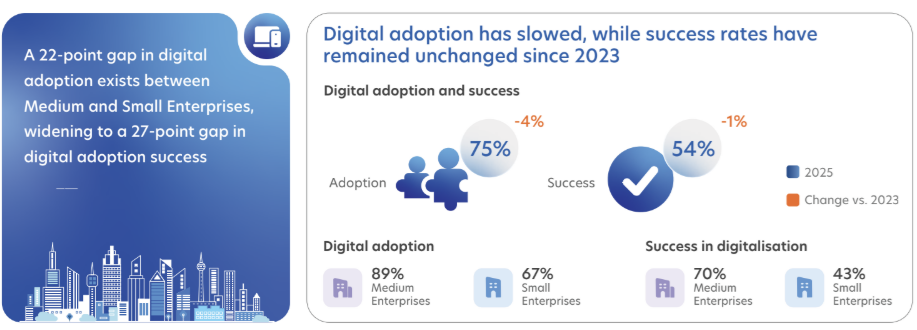
Digitalisation offers a critical approach for Malaysian businesses to drive growth. Many have already embraced new technologies, with over seven in 10 businesses adopting digital solutions in at least one department.
Yet Small Enterprises, in particular, still grapple with a wide gap between execution and outcome. Whereas seven in 10 Medium Enterprises report great success in their digitalisation efforts, only two in five Small Enterprises say the same. Some common roadblocks to digital transformation include high implementation costs, a lack of digital skills among employees, and cybersecurity concerns.
Companies that manage to overcome these barriers, however, gain a significant competitive advantage. Digitalisation continues to be key in driving productivity for 43 per cent of businesses, while enhancing business performance (37 per cent) and increasing profitability (37 per cent).
In 2026, seven in 10 firms plan to increase digital investments by 10 to 50 per cent, signalling continued confidence in digital transformation. Businesses must work closely with ecosystem partners that can help defray implementation costs and accelerate their journey.
Amid the rapid rise of AI, Malaysia’s enterprises are beginning to explore new possibilities. Businesses that have deployed AI report tangible benefits for their bottom line, ranging from productivity gains (51 per cent) to cost reduction (48 per cent) and revenue growth (44 per cent).
At the same time, AI adoption remains in its early stages. Across the board, only 53 per cent of companies currently use AI.
This percentage is higher in the Manufacturing and Engineering & Industrials sectors, where digital maturity is more advanced. Small Enterprises lag behind significantly, with a 20-point gap in adoption as compared to Medium Enterprises.
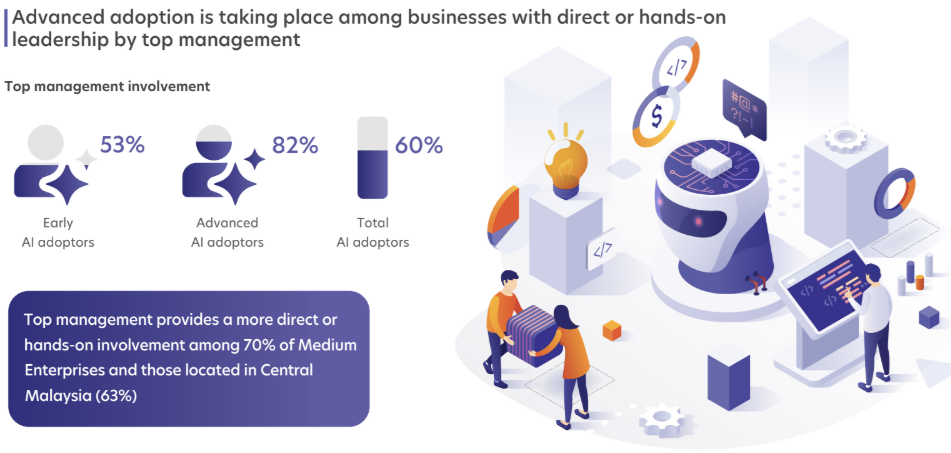
Common barriers to AI adoption and scale-up include cost constraints, data and system readiness issues, as well as regulatory and compliance concerns – especially among smaller firms.
In response, more than four in five businesses plan to boost their AI budgets in 2026, with Medium Enterprises reporting the strongest budget increase. Financial providers will need to offer enhanced funding solutions for smaller businesses to achieve AI transformation and avoid falling behind.
Sustainability remains a work in progress for many businesses. The importance of sustainability has declined by six percentage points since 2023, with fewer small businesses citing ESG considerations as important. This trend may reflect the impact of rising inflation, which is pushing businesses to shift priorities towards cost management instead.
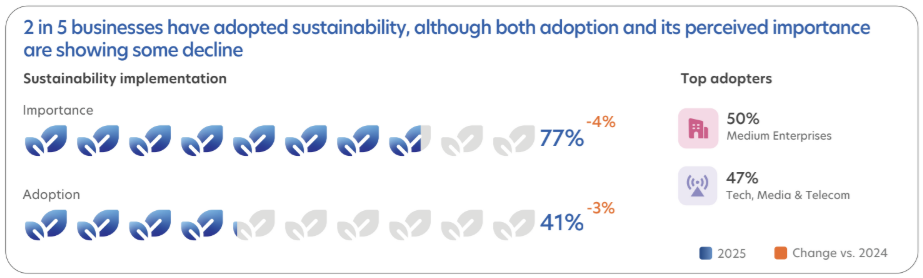
Implementation of sustainable practices remains relatively flat year-on-year, with only two in five enterprises currently doing so. This hesitation arises from key barriers, such as lack of awareness (31 per cent), higher costs passed to customers (30 per cent), and limited government or financial support (26 per cent).
Encouragingly, Malaysian businesses are increasingly viewing sustainable action as a competitive lever (46 per cent) and a way to build a sustainable future (42 per cent), rather than simply a strategy to attract investors and customers. In addition, more companies are focusing on sustainable practices relating to employee welfare (49 per cent) and mental wellness (40 per cent), reflecting a broader shift towards more people-centred growth.
As geopolitical tensions in the Middle East disrupt global oil and gas supplies, managing energy costs has become an urgent priority for businesses. Nearly eight in 10 businesses highlight energy management and efficiency as important, especially for Medium Enterprises.
Businesses are mainly focusing on reducing energy consumption (48 per cent), lowering energy costs (44 per cent), and ensuring stable energy supply for operations (40 per cent). Two important strategies gaining popularity are solar energy and LED lighting, with two in five firms adopting these solutions to achieve cost savings.
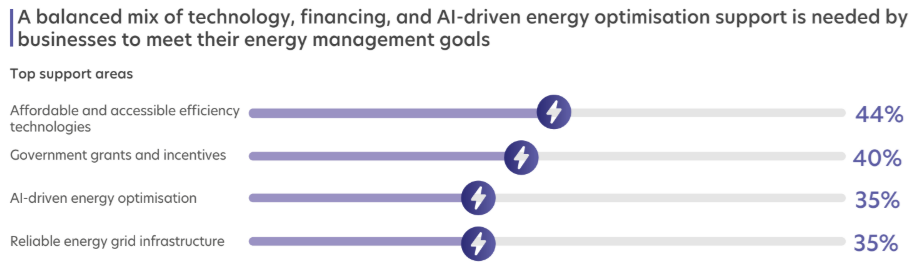
While businesses need more energy-efficient solutions, they face the challenge of high upfront investment costs combined with limited technical expertise. Stronger government incentives and more accessible technologies like AI will be key enablers to help them reduce operating costs, improve operational stability, and meet customer expectations in 2026.
While supply chain disruption reached a peak during the announcement of widespread US tariffs in early 2025, the business landscape has since stabilised. Around 42 per cent of enterprises report their supply chains being significantly impacted by geopolitical tensions – down from 86 per cent previously.
Nevertheless, supply chain management remains vital to business success, with 83 per cent of companies rating it as important. This is especially true for medium enterprises and industries that rely on efficient logistics, such as manufacturing, engineering, and industrial sectors.
One key challenge for supply chains lies in procurement. A third (36 per cent) of our respondents are facing difficulties in sourcing raw materials. To enhance supply chain stability, forward-thinking companies are taking steps to diversify suppliers and source alternative raw materials.
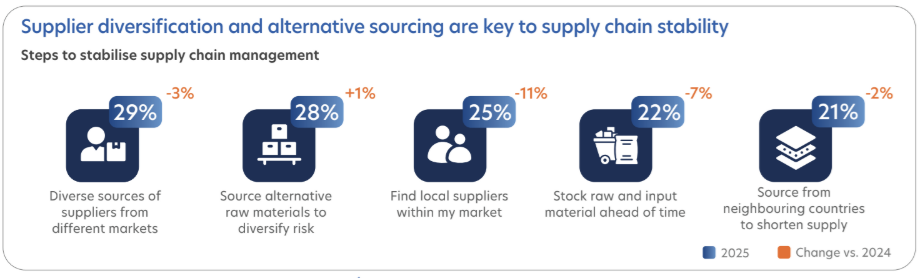
Free trade agreements such as the Regional Comprehensive Economic Partnership (RCEP) are making alternative sourcing easier by lowering barriers to trade in ASEAN and beyond. At the same time, China-Plus-One strategies are gaining traction as businesses complement their China operations with investment in other markets.
However, the effectiveness of these solutions remains limited. Lack of clarity around “Local Content” and “Country of Origin” regulations affects over eight in 10 businesses, complicating their supply chain planning. Moreover, many companies still rely on Chinese manufacturing for intermediate processing or imports.
To tackle these procurement challenges, Malaysia’s businesses are accelerating their diversified sourcing efforts. Three in five respondents plan to further diversify suppliers in 2026, both locally and across ASEAN.
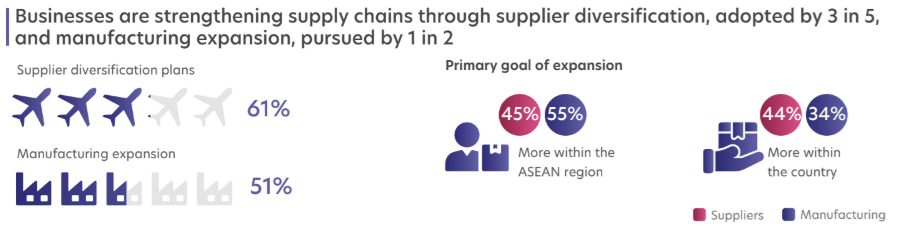
A strategic shift towards nearshoring is also under way. Over half of businesses have plans to set up manufacturing bases within Malaysia or ASEAN to strengthen their supply chains. Through these expansion strategies, firms hope to benefit from access to new markets (62 per cent), build resilience (57 per cent), as well as optimise costs (51 per cent).
To reinforce resilience, businesses are doubling down on risk diversification and operational efficiency. Medium enterprises, in particular, are tapping digital innovation to bolster their agility.
At the moment, many remain constrained by high operational costs, technology integration challenges, and supplier reliability issues. Addressing these gaps will be key to unlocking true resilience.
Malaysia’s ambitious businesses are keen to seize opportunities abroad. Led by medium enterprises, nearly two in five firms expanded overseas in 2025. ASEAN was the top destination of choice for 66 per cent of respondents.
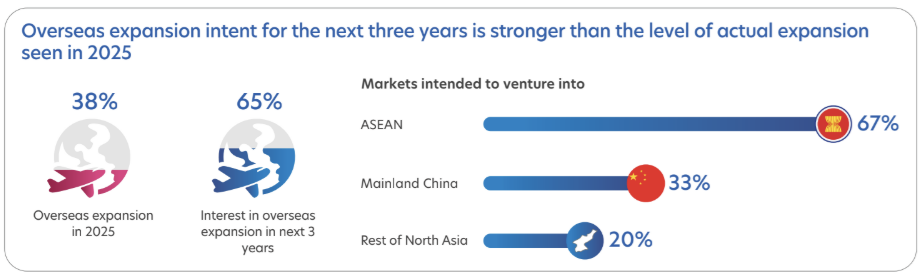
While interest in overseas expansion over the next three years remains keen, this trend has eased as businesses approach growth more strategically. Rather than expanding to drive profits or revenue growth, they are increasingly focused on building a robust manufacturing base overseas. This motivation has climbed by 23 percentage points since our 2023 study, reflecting the broader urgency of supply chain diversification in an uncertain global landscape.
Beyond expansion, around three in five companies plan to invest overseas through foreign direct investment (FDI). This move is being driven by China-Plus-One diversification, along with a push to move operations nearer customers.
ASEAN is the primary FDI destination for the majority of firms (52 per cent), followed by Mainland China (27 percent). On average, companies plan to invest USD 13 million over the next 12 to 24 months, with most investments falling in the USD 1 to 25 million range.
Malaysia’s businesses face a fast-evolving landscape ahead, and adaptability will hold the key to success. Digitalisation and AI adoption, sustainable action, efficient energy management, and supply chain diversification can no longer be treated in isolation – they are converging priorities that enable companies to stay agile.
At UOB, we are committed to helping businesses unlock agility with financing solutions, regional trade support, digital tools, and market expertise. Contact us to find out more.

The UOB Business Outlook Study 2026 (Malaysia) H1 surveyed 268 business owners and senior executives from Small and Medium Enterprises in Malaysia. Conducted online in January 2026 the study offers insights into:
The H1 2026 edition also introduces three new Pulse Topics, offering deeper insights into emerging business priorities:
This article shall not be copied or relied upon by any person for whatever purpose. This article is given on a general basis without obligation and is strictly for information only. The information contained in this article is based on certain assumptions, information and conditions available as at the date of the article and may be subject to change at any time without notice. You should consult your own professional advisers about the issues discussed in this article. Nothing in this article constitutes accounting, legal, regulatory, tax or other advice. This article is not intended as an offer, recommendation, solicitation, or advice to purchase or sell any investment product, securities or instruments. Although reasonable care has been taken to ensure the accuracy and objectivity of the information contained in this article, UOB and its employees make no representation or warranty, whether express or implied, as to its accuracy, completeness and objectivity and accept no responsibility or liability for any error, inaccuracy, omission or any consequence or any loss or damage howsoever suffered by any person arising from any reliance on the views expressed and the information in this article.



Get the UOB Business Outlook Study 2026 (Malaysia) H1.Download now