You are now reading:
UOB Business Outlook Study 2026 (Thailand) H2: Businesses Strengthen Resilience and Pursue New Growth Opportunities

Find out how we can help you fast-track your investments in the JS-SEZ.
Learn more
you are in UOB ASEAN Insights


You are now reading:
UOB Business Outlook Study 2026 (Thailand) H2: Businesses Strengthen Resilience and Pursue New Growth Opportunities
Thai businesses are entering the second half of 2026 with renewed confidence, even as geopolitical tensions, rising energy prices, and supply-chain disruptions add to operating pressures. Despite an uncertain business environment, companies are investing in digitalisation and artificial intelligence (AI), strengthening their supply chains and business networks, and exploring opportunities across ASEAN to support long-term growth.
These are among the findings of the UOB Business Outlook Study 2026 (Thailand) H2, which tracks business sentiment, priorities, and strategies amid evolving economic and geopolitical conditions. Other key findings include:
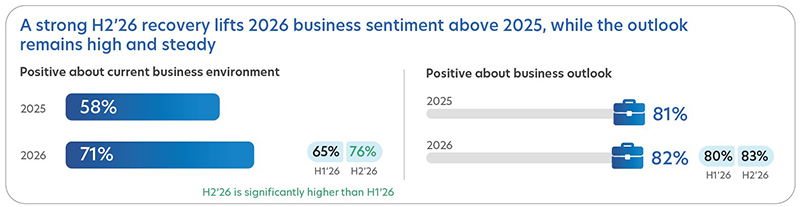
Thai businesses are showing renewed confidence. Led by businesses in Wholesale Trade and Small Enterprises, the majority of respondents (76 per cent) expressed a positive view of business conditions in H2 2026, up from 65 per cent in H1. Future outlook is similarly positive — 83 per cent anticipate business performance to improve in H2, higher than the regional average of 78 per cent.
This optimism persists even against a backdrop of rising uncertainty. Geopolitical tensions have become a more prominent concern, with 33 per cent of businesses identifying them as a key challenge in H2 — a sharp increase from 18 per cent in H1. Rising operating costs remain a significant problem, particularly for those in Construction & Infrastructure, Industrials, Oil & Gas, and Consumer Goods, possibly resulting from heightened geopolitical tensions. More than one in two businesses reported moderate-to-severe impact from the US-Iran conflict, with Manufacturing, Engineering & Industrials and Medium Enterprises being the most vulnerable.
Given this tough climate, businesses are sharpening their growth strategies — from reassessing investments and supply chains to strengthening industry connections. Half (50 per cent) have reduced or paused capital expenditure plans, while 43 per cent are diversifying or nearshoring supply chains away from the Gulf region. Another 42 per cent are accelerating investments in cybersecurity and digital infrastructure resilience.
Building stronger networks has also emerged as a leading strategic priority for 41 per cent of businesses, especially those in Manufacturing, Engineering & Industrials and Professional & Business Services. However, the process of forming and maintaining partnerships is rife with friction. Challenges include negotiating fair terms (cited by 28 per cent of businesses), accessing relevant business networks (26 per cent), and protecting intellectual property (24 per cent).
Digital transformation continues to be an important lever for Thai businesses to improve efficiency, competitiveness and growth. From 86 per cent in H1, digital adoption grew to 90 per cent in H2.
Such enthusiasm may stem from recent fruitful investments. In H2, 79 per cent of businesses reported achieving great or considerable success from digitalisation initiatives, up from 71 per cent in H1. Outcomes include productivity and efficiency gains (39 per cent), greater customer reach (37 per cent), and stronger overall business performance (34 per cent).
Blockchain and distributed ledger technology (DLT) are also emerging as areas of interest. More than half (56 per cent) of businesses are either piloting these technologies or planning to adopt them over the next six to 12 months, with nine in 10 citing improved operational efficiency as the key benefit. Adoption is strongest among Medium Enterprises (97 per cent), firms in Consumer Goods (97 per cent), and companies based in the Rest of Thailand (95 per cent).
Nevertheless, challenges to effective implementation remain. Businesses cite skills gaps (44 per cent) and cybersecurity concerns (44 per cent) as top constraints — reflecting the need to balance technology initiatives with investments in people and safeguards.
AI adoption among Thai businesses accelerated to 92 per cent in H2 2026 from 71 per cent in H1. Notably, the proportion of businesses at advanced stages of AI adoption has more than doubled, from 17 per cent to 36 per cent.
Customer Service & Support is the leading area where businesses see value from AI, cited by 53 per cent of respondents. This is followed closely by Operations & Process Automation (51 per cent) and Sales & Marketing (45 per cent). While these functions seem universal, AI investments are becoming more use-case-driven. Businesses across sectors are prioritising tailored applications that best address their specific needs for productivity, insights and customer support.
As AI deployment grows, businesses are recognising the need for governance structures. The majority of businesses in Thailand (90 per cent) have established some form of AI governance framework — higher than the regional average of 81 per cent. However, around half of these frameworks remain at a basic policy level and have yet to be fully implemented across departments.
Rather than relying primarily on external recruitment to acquire AI capabilities, businesses are taking a more human-centred approach to transformation. Nearly half (48 per cent) are prioritising job redesign, while 26 per cent are focusing on reskilling and upskilling existing employees. Only 15 per cent are prioritising external AI hiring.
Interest in agentic AI is also gaining traction. More than half (54 per cent) of businesses have deployed multi-agent systems or are actively piloting or planning their deployment — higher than the regional average of 51 per cent — and 89 per cent of businesses expect their AI budgets to increase. This signals continued confidence in AI outcomes among businesses.
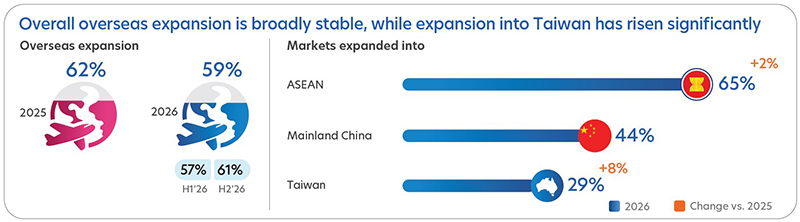
Overseas expansion continues to feature in Thai businesses’ growth strategies. In 2026, 59 per cent of businesses have expanded overseas, with ASEAN continuing to be the leading destination.
Looking ahead, around eight in 10 businesses express interest in pursuing overseas expansion. While most are still eyeing ASEAN, interest in Mainland China also increased sharply, rising from 31 per cent in H1 to 48 per cent in H2.
Within ASEAN, Singapore, Vietnam, and Malaysia are the leading markets of interest for future expansion. Interest in Singapore and Vietnam has also increased significantly compared with 2025, while interest in Malaysia has declined.
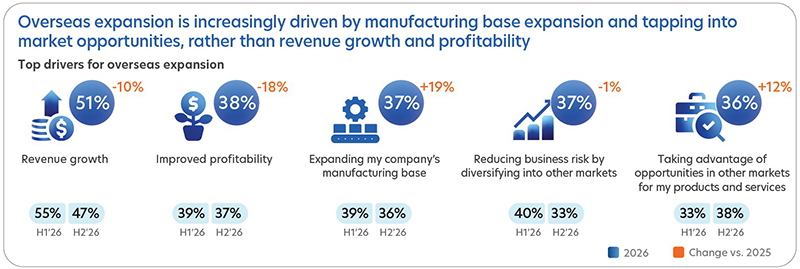
The motivations behind overseas expansion are evolving. Businesses are looking to expand manufacturing capacity (up 19 percentage points compared to 2025) and capture opportunities in other markets (up 12 percentage points compared to 2025), rather than focusing solely on revenue growth and profitability, which declined by 10 and 18 percentage points, respectively. However, a lack of in-house talent and difficulties in finding suitable business partners remain important barriers to international expansion.
Similarly, investment intentions are strong — 78 per cent of businesses are likely to make foreign direct investments (FDI) over the next 12 to 24 months, with ASEAN attracting the largest share of intended investments.
Sustainability continues to be an important consideration for 97 per cent of Thai businesses. But priorities are shifting — sustainability is becoming less about enhancing corporate reputation and more about building a sustainable future. Businesses are seeking practical initiatives that deliver both immediate operational benefits and longer-term outcomes.
Resource efficiency is the leading measure — adopted by 49 per cent of businesses — followed by energy-efficient technologies (44 per cent) and implementing clear operational policies and processes (42 per cent). These initiatives are especially prominent in the Construction & Infrastructure sector, which has a high energy footprint.
Even as these efforts support business resilience, they also give rise to other challenges. Businesses worry about passing higher costs on to customers (35 per cent), protecting profitability (33 per cent), and managing the potential impact on short-term revenue (31 per cent).
On top of these concerns, businesses remain wary of volatility in global energy markets due to ongoing geopolitical tensions. Some 60 per cent of Thai businesses are very or extremely concerned about energy-price volatility. Concern is particularly pronounced among Manufacturing, Engineering & Industrials businesses and Medium Enterprises.
As a result, around 96 per cent regard energy management and efficiency as important in 2026 — higher than the regional average of 89 per cent. Anticipating future price-shocks and disruptions, 83 per cent of businesses are already implementing measures to manage energy-related challenges. Initiatives include accelerating investments in on-site renewable energy (46 per cent), energy-efficiency measures (40 per cent), and battery storage or captive power systems (40 per cent). However, implementation is constrained by high upfront investment costs, limited internal resources, and a lack of technical expertise.
The UOB Business Outlook Study 2026 (Thailand) H2 points to a business environment characterised by renewed confidence, but also greater awareness of the risks posed by geopolitical uncertainty, rising costs, and supply-chain disruptions.
Despite these challenges, Thai businesses are continuing to invest in the capabilities they believe will support long-term competitiveness. Digitalisation and AI adoption are accelerating, supply-chain strategies are becoming more diversified, and partnerships and overseas expansion remain important avenues for growth. At the same time, sustainability and energy management are gaining prominence as businesses look to improve operational efficiency and build resilience.
The challenge now lies in translating these priorities into sustainable business outcomes. This will require careful investment decisions, access to financing and expertise, and the ability to build trusted partnerships across markets.
With its extensive regional network and deep understanding of businesses across ASEAN, UOB is committed to supporting Thai businesses as they navigate an evolving operating environment, strengthen their resilience, and capture new opportunities for growth. Contact us to find out how UOB can support your business.

18 Nov 2026 • 6 MINS READ

17 Nov 2026 • 6 MINS READ

Get the UOB Business Outlook Study 2026 (Thailand) H2. Download now.