You are now reading:
ASEAN Consumer Sentiment Study 2026 (Vietnam): Consumers Feel Financial Pressures but Hold High Hopes for the Economy
Find out how we can help you fast-track your investments in the JS-SEZ.
Learn more
you are in UOB ASEAN Insights


You are now reading:
ASEAN Consumer Sentiment Study 2026 (Vietnam): Consumers Feel Financial Pressures but Hold High Hopes for the Economy
Consumer sentiment is down compared with last year, but many are hopeful about the future. Rising living costs, environmental risks, and long-term financial obligations are weighing on Vietnamese consumers’ confidence and making them more cautious about their financial prospects. Despite these pressures, many remain optimistic about what tomorrow may bring, with 80 per cent expecting a better financial situation compared with only 77 per cent in 2025.
These are among the findings from this year’s ASEAN Consumer Sentiment Study, UOB’s regional flagship report analysing consumer trends and sentiments across Singapore, Malaysia, Thailand, Indonesia, and Vietnam. The study reveals how Vietnamese consumers are redefining wealth, navigating the growing role of artificial intelligence (AI) in financial decisions, and balancing immediate household needs with long-term financial security.
From a macro perspective, consumer sentiment about the current and future economic environment remains the same among Vietnamese consumers. Just like in 2025, 84 per cent remain positive about the economic situation. However, many have expressed deepening concerns about their surrounding environment (81 per cent), finances (80 per cent), work-related matters (72 per cent), and their health and wellbeing (71 per cent).
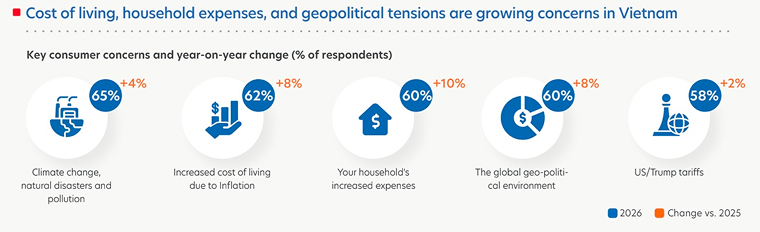
Environmental risks are a prominent concern in Vietnam. Compared to other consumers within the region, who are most worried about the increased cost of living due to inflation, Vietnamese are most concerned about climate change, natural disasters, and pollution (65 per cent) – more so compared to 2025 (61 per cent).
Much of the country’s economic activity and population is concentrated along densely populated coastlines, leaving communities and businesses vulnerable to rising sea levels, extreme weather, and other environmental disruptions. The country’s increasing greenhouse gas emissions add another dimension to the challenge of building long-term climate resilience.
Meanwhile, inflation and mounting household expenses are placing additional pressure on consumers’ finances. Vietnam’s consumer price index (CPI) rose 0.62 per cent month on month in September, while increasing 5.08 per cent year on year. Over half of Vietnamese consumers (52 per cent) say inflation has negatively affected their household’s purchasing power.
Although Vietnamese consumers are less concerned than many of their regional counterparts about meeting essential financial obligations, some continue to struggle with competing priorities. One in four (25 per cent) are concerned about their ability to put money aside for savings, while 23 per cent worry about affording essential items for themselves and their families. Another 22 per cent are concerned about meeting their parents’ financial and healthcare needs.
The latter concern alludes to Vietnam’s ageing population. People aged 60 and above are projected to account for approximately 25 per cent of the country’s population by 2050, increasing the importance of planning for healthcare costs and intergenerational financial support.
In response to inflation, consumers are adopting practical spending habits to make their money go further: 33 per cent are cutting non-essential expenditure, while 30 per cent are tracking their expenses, and 26 per cent are seeking better deals.
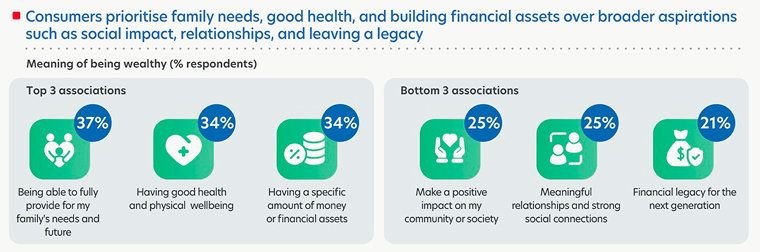
For Vietnamese consumers, wealth extends beyond financial assets to encompass family responsibilities, personal wellbeing and contributions to society.
When asked what wealth means to them, many identified the ability to provide for their families as a key measure (37 per cent), followed by good health and physical wellbeing (34 per cent), and having a specific amount of money or financial assets (34 per cent).
Notably, one in four respondents (25 per cent) also associate wealth with making a positive impact on society and having meaningful relationships and strong social connections. Both considerations rank higher among Vietnamese consumers than the regional average, underscoring how personal relationships and social contributions form part of their aspirations for a fulfilling life.
Regarding their ability to meet their definition of wealth, Vietnamese consumers equally cited economic uncertainty, unexpected expenses, and the high cost of living as obstacles, at 24 per cent each.
While they are among the more open consumers in the region when it comes to discussing wealth (85 per cent compared with the regional average of 80 per cent), they tend to make investment decisions independently.
To gain insights or assist with their financial decision-making, 40 per cent said they engage a financial advisor, more so than others in the region, with the regional average being 32 per cent.
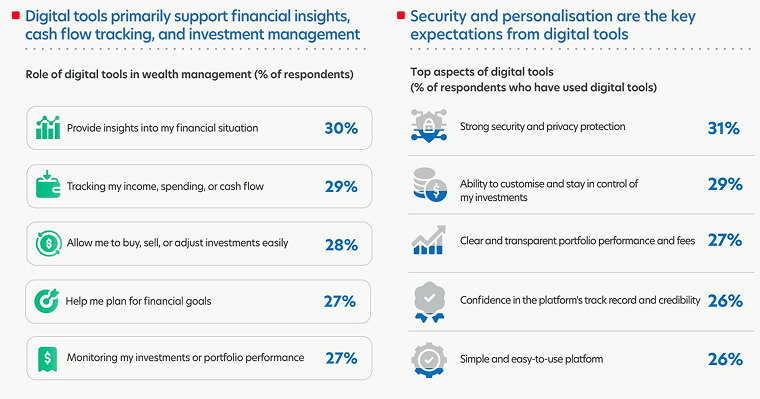
Digital tools also play an increasingly important role, with 85 per cent of Vietnamese consumers using digital wealth management tools. Their primary uses include gaining insights into their financial situation (30 per cent), tracking spending, income, or cash flow (29 per cent), and buying, selling, or adjusting investments (28 per cent).
The features they value reflect their preference for control and transparency. Nearly a third (31 per cent) prioritise strong security and privacy protection, while 29 per cent want the ability to customise and remain in control of their investments. Another 27 per cent value clear and transparent information on portfolio performance and fees.
This combination of digital convenience and independent decision-making does not mean human guidance has become less important. Vietnamese consumers continue to turn to relationship managers for help navigating fees and charges (33 per cent), receiving investment recommendations (32 per cent), and understanding complex financial products (32 per cent).
The value of human advice lies in qualities that can be difficult to replicate through technology alone. Respondents identify trust (33 per cent), personalised advice (31 per cent), and nuanced judgement in complex or uncertain situations (31 per cent) as key reasons for seeking support from relationship managers.
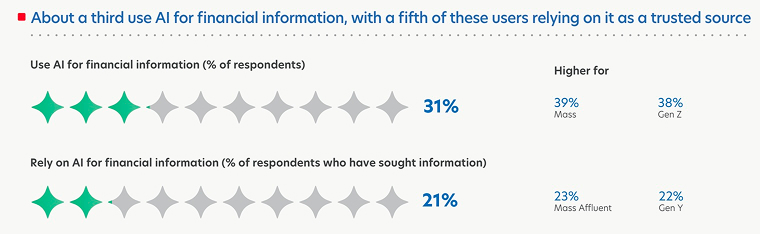
AI is becoming an increasingly familiar part of how Vietnamese consumers access financial information and make decisions. More than half use AI tools, including chatbots and voice-enabled assistants, for financial activities daily.
AI has also emerged as one of their leading sources of financial information, behind banks (39 per cent) and search engines (35 per cent). Its growing role extends beyond gathering information, with nearly nine in 10 Vietnamese consumers having made financial decisions with AI assistance.
The most common applications include comparing banking products (38 per cent), understanding financial information or documents (33 per cent), and making budgeting, spending, and savings decisions (30 per cent).
Within banking, consumers are particularly interested in AI features that can help them manage money more proactively. Nearly half (49 per cent) value personalised savings nudges aligned with their lifestyle or life-stage goals. Smart product recommendations based on spending behaviour are also popular, cited by 43 per cent, followed by alerts that help prevent overspending (42 per cent).
These applications point to opportunities for financial institutions to use AI to make financial management more personalised, timely, and accessible. By helping consumers identify spending patterns, compare options, and stay on track with their goals, AI-powered services can support more informed everyday decisions.
However, the widespread use of AI does not necessarily translate into greater trust in the technology. Vietnamese consumers are more likely to trust peers or family members (82 per cent), human financial advisors or wealth managers (77 per cent), and even financial planning apps or budgeting tools (76 per cent) to act in their best financial interests than AI platforms.
Despite mounting financial pressures, Vietnamese consumers are demonstrating discipline in preparing for unexpected expenses and building wealth over time. Their approach combines regular savings, emergency funds, insurance, and investment, although longer-term planning remains an area for further attention.
The majority (92 per cent) of Vietnamese consumers feel confident in their ability to manage their personal finances effectively. While this represents a two-percentage-point decrease from 2025, the findings suggest that financial confidence remains widespread.
Their savings habits offer further evidence of this resilience. The number of Vietnamese consumers saving at least 10 per cent of their income increased from 82 per cent in 2025 to 89 per cent in 2026 – notably higher than the regional average of 77 per cent.
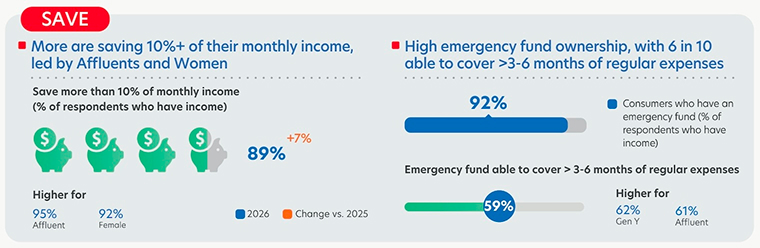
Emergency funds are also widely established. Some 92 per cent say they have an emergency fund, while 59 per cent have enough savings to cover at least three to six months of expenses, an increase of two percentage points from the previous year.
Insurance is another important component of financial resilience in Vietnam. Nearly two in five consumers have life insurance, while around one-third have basic health and personal accident insurance.
Among those with death and total permanent disability as well as critical illness coverage, about half have insurance benefits equivalent to one to three times their annual income. However, maintaining adequate protection comes at a cost.
More than three in four Vietnamese consumers spend up to 15 per cent of their annual salary on insurance premiums, representing a sizeable commitment within household budgets. For consumers already managing inflation and rising living expenses, balancing insurance coverage with everyday needs and savings goals can be challenging.
Vietnamese consumers are also putting more of their income into investments, suggesting that wealth-building efforts extend beyond maintaining financial buffers.
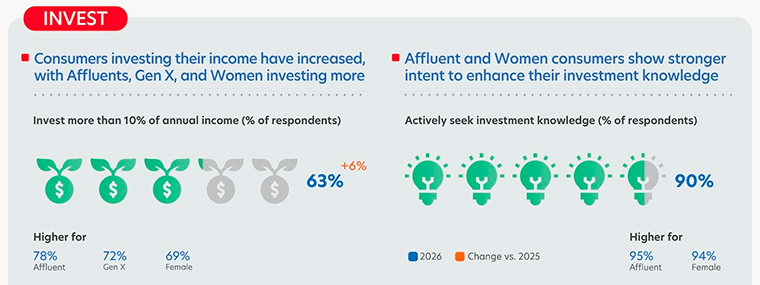
The proportion investing more than 10 per cent of their annual income rose from 57 per cent in 2025 to 63 per cent in 2026, exceeding the regional average of 58 per cent. Among Vietnamese consumers who invest, 40 per cent have a high risk appetite.
While savings and investment habits are strengthening, Vietnamese consumers appear less certain about their longer-term financial plans.
Most consumers say they have a good idea of how much money they will need to retire comfortably, but that figure is down from 83 per cent in 2025 to 77 per cent in 2026. More than six in 10 have also taken steps towards legacy planning, although progress is slower than in the rest of the region.
Vietnamese consumers are taking meaningful steps to strengthen their financial resilience. More are setting aside savings, maintaining emergency funds, and increasing their investments, even as inflation, environmental concerns, and the cost of financial protection place pressure on household budgets.
Technology will be an important part of their financial journeys, with AI becoming a regular tool for managing money and accessing financial information. However, Vietnamese consumers continue to place considerable trust in family members, financial advisors, and relationship managers.
Understanding what wealth means to Vietnamese consumers is central to building stronger relationships and developing solutions that support their financial needs today and in the years ahead. Explore the full findings of UOB’s 2026 ASEAN Consumer Sentiment Study to discover how consumer attitudes towards wealth, savings, and financial decision-making are evolving across the region.

The ASEAN Consumer Sentiment Study (ACSS) is UOB’s flagship regional survey, tracking consumer trends and sentiment across five key markets: Singapore, Malaysia, Thailand, Indonesia and Vietnam.
Now in its seventh year, the 2026 edition of the study was conducted in June and captures the views of 5,000 consumers, with 1,000 respondents from each country.
Key topics covered include:
This article shall not be copied or relied upon by any person for whatever purpose. This article is given on a general basis without obligation and is strictly for information only. The information contained in this article is based on certain assumptions, information and conditions available as at the date of the article and may be subject to change at any time without notice. You should consult your own professional advisers about the issues discussed in this article. Nothing in this article constitutes accounting, legal, regulatory, tax or other advice. This article is not intended as an offer, recommendation, solicitation, or advice to purchase or sell any investment product, securities or instruments. Although reasonable care has been taken to ensure the accuracy and objectivity of the information contained in this article, UOB and its employees make no representation or warranty, whether express or implied, as to its accuracy, completeness and objectivity and accept no responsibility or liability for any error, inaccuracy, omission or any consequence or any loss or damage howsoever suffered by any person arising from any reliance on the views expressed and the information in this article.

17 Nov 2026 • 6 MINS READ

16 Nov 2026 • 7 mins read