You are now reading:
ASEAN Consumer Sentiment Study 2026 (Thailand): Growing Financial Confidence, Grounded in Stability

Find out how we can help you fast-track your investments in the JS-SEZ.
Learn more
you are in UOB ASEAN Insights


You are now reading:
ASEAN Consumer Sentiment Study 2026 (Thailand): Growing Financial Confidence, Grounded in Stability
Thai consumers are feeling more optimistic about the economy and their financial futures, with growing confidence reflected in their saving habits, investment decisions, and long-term financial planning. As confidence improves, they are also gradually easing back on cost-cutting measures.
Based on UOB’s 2026 ASEAN Consumer Sentiment Study (Thailand), this article explores how persistent concerns about inflation, household expenses, and geopolitical uncertainty continue to shape how Thai consumers manage their money, plan for the future, and define financial well-being.
Thai consumers are feeling more positive about the current and future economic environment compared to last year. Half (50 per cent) now express optimism about the current and future economic environment, up from 39 per cent in 2025. More consumers also expect their financial situations to improve over the next 12 months.
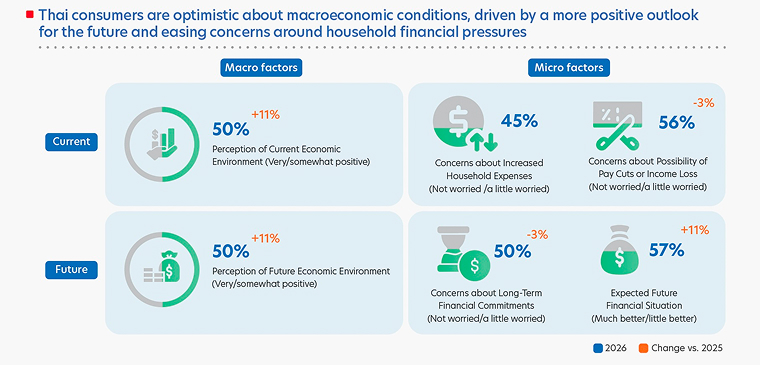
Despite this more positive outlook, economic pressures remain. The rising cost of living due to inflation is a concern for 61 per cent of Thai consumers, followed by climate change, natural disasters, and pollution (60 per cent), and higher household expenses (55 per cent).
Inflation, in particular, is affecting purchasing power. Nearly three in four Thai consumers (72 per cent) say inflation has negatively affected their ability to buy goods and services, exceeding the regional average of 65 per cent.
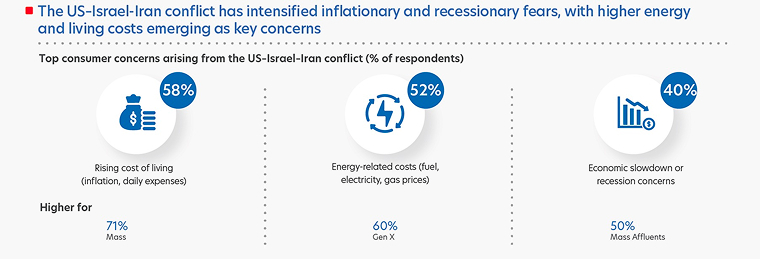
Geopolitical uncertainty is adding to these concerns. The ongoing US-Israel-Iran conflict has heightened worries about the rising cost of living (58 per cent), energy-related costs (52 per cent), and an economic slowdown or recession (40 per cent) among Thai consumers, with all three concerns exceeding regional averages.
Nevertheless, consumers appear to be easing some of their responses to inflation. Compared to 2025, fewer are cutting back on non-essential purchases (44 per cent, down from 52 per cent), tracking expenses (38 per cent, down from 44 per cent), and looking for discounts (32 per cent, down from 42 per cent).
Thailand’s consumer price index rose 2.82 per cent in September, up from 2.53 per cent in August, as severe flooding affected food prices. Despite the increase, inflation remained below the 3.1 per cent median forecast in a Bloomberg survey of economists.
For Thai consumers, wealth is about more than accumulating money or assets. It is closely tied to financial security, family responsibilities, and personal well-being.
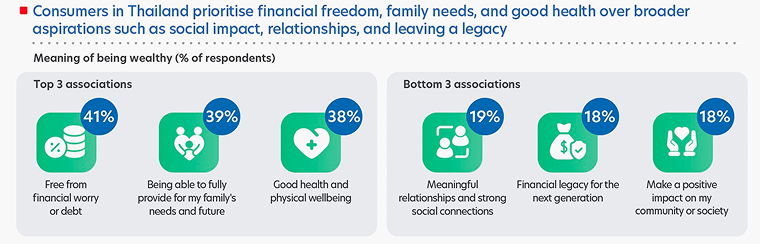
The study found that 41 per cent of Thai consumers define being wealthy as being free from financial worries or debt. Another 39 per cent associate wealth with being able to provide for their family’s needs and future, while 38 per cent see good health and physical well-being as essential.
These priorities reflect the importance of financial stability in a country where household debt remains a significant concern. Average household debt in Thailand has reached nearly 800,000 baht (approximately US$23,690), with the household debt-to-GDP ratio standing at 85 per cent.
Against this backdrop, being debt-free can represent more than a financial milestone: it can provide greater peace of mind and the flexibility to plan for the future. Similarly, the ability to support family members highlights how wealth is often measured by what consumers can provide for their loved ones, rather than by personal assets alone.
However, achieving these goals is not always straightforward. The high cost of living is the biggest obstacle to wealth for 41 per cent of Thai consumers, followed by economic uncertainty at 39 per cent.
Thai consumers generally prefer to take charge of their financial decisions. The majority (73 per cent) make most of their investment choices independently, exceeding the regional average of 69 per cent.
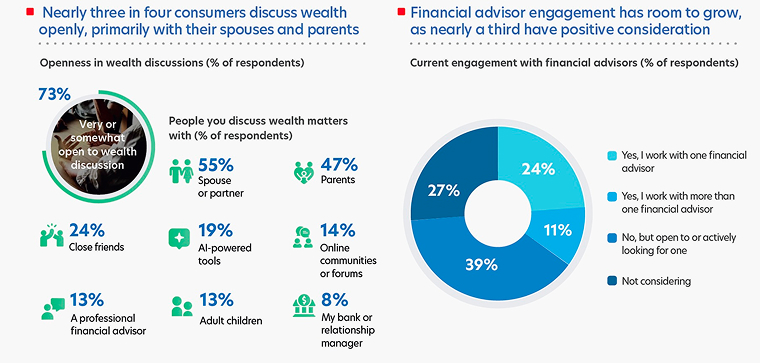
Although they are comfortable managing their finances on their own, many are also willing to discuss wealth with others. 73 per cent of Thai consumers are open to these conversations, although this is below the regional average of 80 per cent. Their most common discussion partners are their spouse or partner (55 per cent), parents (47 per cent), and close friends (24 per cent).
Digital tools are an important part of this independent approach. The majority of respondents (95 per cent) use digital tools for wealth management, primarily to invest (39 per cent), plan financial goals (35 per cent), and gain insights into their financial situation (33 per cent).
When choosing these tools, consumers place particular importance on strong security and privacy protection (37 per cent), the ability to view and track investments in real time (31 per cent), and simple, easy-to-use platforms (28 per cent).
Yet, digital convenience does not eliminate the need for human expertise. More than three in 10 Thai consumers engage a dedicated financial advisor, with many recognising the value that dedicated relationship managers bring to complex financial decisions.
Specifically, 38 per cent value their ability to exercise nuanced judgement in complex or uncertain situations, 36 per cent appreciate personalised advice tailored to their financial circumstances, and 35 per cent value their support when making decisions during volatile or stressful market conditions.
Thai consumers are also showing a growing willingness to use artificial intelligence (AI) in managing their finances, outpacing their regional peers in several areas.
Nearly one in five (19 per cent) are open to discussing their wealth goals with AI tools, compared to the regional average of 16 per cent. Half (50 per cent) use AI daily for financial activities, exceeding the regional average of 46 per cent.
AI is becoming one of several sources of financial information. Some 42 per cent of Thai consumers use AI-powered tools to obtain financial information, although social media (45 per cent), banks (44 per cent), and search engines (43 per cent) remain more commonly used sources.
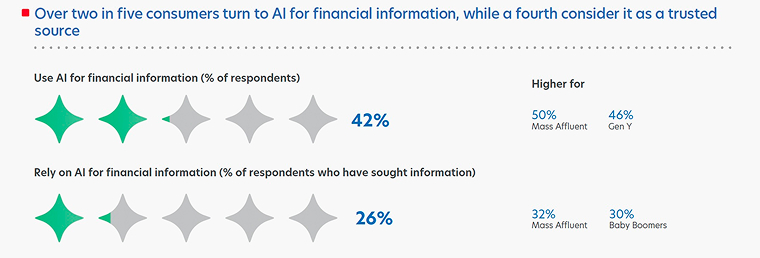
AI is also influencing financial decisions. More than four in five Thai consumers have made financial decisions based on AI advice, with outcomes largely reported as positive. Common applications include comparing banking products (43 per cent), understanding financial information or documents (35 per cent), and making budgeting, spending, and saving decisions (33 per cent).
Consumers also see potential for AI to improve their banking experience. They particularly value alerts that help prevent overspending (43 per cent), investment recommendations tailored to their goals and risk profiles (41 per cent), and smart product recommendations based on their spending and behaviour (40 per cent).
However, greater adoption does not necessarily translate into greater trust. Thai consumers continue to place more confidence in established sources of financial guidance, including their primary bank (78 per cent), financial planning apps (74 per cent), family members (73 per cent), and wealth managers (72 per cent).
This reliance on established sources of guidance sits alongside a strong sense of financial self-confidence. Some 87 per cent of Thai consumers feel confident in their overall ability to manage their personal finances effectively.
Beyond their day-to-day financial decisions, Thai consumers are taking steps to strengthen their long-term financial security. However, their progress in saving and planning does not always extend to insurance protection.
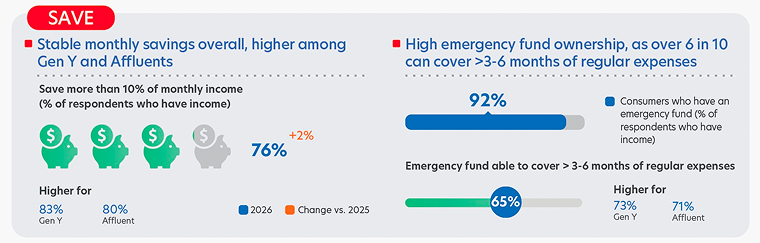
Three in four Thai consumers save more than 10 per cent of their income, a proportion slightly below the regional average but higher than in 2025. Emergency preparedness has also improved: 92 per cent have an emergency fund, compared to just 83 per cent in 2025. What’s more, 65 per cent say they have enough in their emergency funds to cover at least three to six months of expenses, compared to just 59 per cent in 2025.
However, ownership of critical illness insurance, term life insurance, and life insurance has declined since 2025. Among consumers who have insurance, more than three in four spend up to 15 per cent of their annual salary on premiums, particularly men.
Investment behaviour presents another dimension of their financial outlook. Nearly six in 10 Thai consumers invest more than 10 per cent of their annual income. Although their risk appetite has declined significantly since 2025, it remains higher than the regional average. Some 46 per cent invest in high-risk, high-return investments, compared to 40 per cent regionally.
Thai consumers are also looking further ahead when it comes to retirement and legacy planning. About 77 per cent have a fair to good understanding of how much they need to retire comfortably, exceeding the regional average of 73 per cent. Meanwhile, 71 per cent have started legacy planning, with more consumers putting advance care plans in place compared to the previous year.
Thai consumers are approaching their finances with greater confidence and a stronger focus on the future. They are saving more, preparing for retirement, and exploring new ways to make financial decisions, including the use of AI and investments with higher potential returns.
Yet, their definition of wealth remains firmly rooted in financial stability, the ability to provide for family, and good health. Persistent concerns about living costs and economic uncertainty, alongside declining insurance ownership, also show that greater confidence does not remove the need for financial protection and resilience.
For financial institutions, understanding these priorities is key to building lasting relationships with Thai consumers. By combining accessible digital tools and emerging technologies with personalised advice and relevant financial solutions, providers can help consumers navigate immediate challenges while working towards their long-term goals.
UOB is committed to supporting consumers as they build financial confidence and work towards sustainable growth. Explore the full findings of UOB’s 2026 ASEAN Consumer Sentiment Study to discover how attitudes towards wealth, savings, and financial decisions are evolving across the region. Download the report here.

The ASEAN Consumer Sentiment Study (ACSS) is UOB’s flagship regional survey, tracking consumer trends and sentiment across five key markets: Singapore, Malaysia, Thailand, Indonesia and Vietnam.
Now in its seventh year, the 2026 edition of the study was conducted in June and captures the views of 5,000 consumers, with 1,000 respondents from each country.
Key topics covered include:
This article shall not be copied or relied upon by any person for whatever purpose. This article is given on a general basis without obligation and is strictly for information only. The information contained in this article is based on certain assumptions, information and conditions available as at the date of the article and may be subject to change at any time without notice. You should consult your own professional advisers about the issues discussed in this article. Nothing in this article constitutes accounting, legal, regulatory, tax or other advice. This article is not intended as an offer, recommendation, solicitation, or advice to purchase or sell any investment product, securities or instruments. Although reasonable care has been taken to ensure the accuracy and objectivity of the information contained in this article, UOB and its employees make no representation or warranty, whether express or implied, as to its accuracy, completeness and objectivity and accept no responsibility or liability for any error, inaccuracy, omission or any consequence or any loss or damage howsoever suffered by any person arising from any reliance on the views expressed and the information in this article.

17 Nov 2026 • 6 MINS READ

16 Nov 2026 • 7 mins read


Get the ACSS 2026 Thailand infographics.Download now