You are now reading:
ASEAN Consumer Sentiment Study 2026 (Indonesia): Rising Financial Pressures Reshape Consumer Priorities

Find out how we can help you fast-track your investments in the JS-SEZ.
Learn more
you are in UOB ASEAN Insights


You are now reading:
ASEAN Consumer Sentiment Study 2026 (Indonesia): Rising Financial Pressures Reshape Consumer Priorities
Indonesian consumers are becoming less optimistic about the economy, with overall consumer sentiment declining to 49 per cent in 2026 from 55 per cent in 2025. Reflecting this shift, their perceptions of both the current and future economic environment fell by 12 and nine percentage points, respectively. Rising household expenses, long-term financial commitments, and concerns about their future financial situation are weighing heavily on their minds.
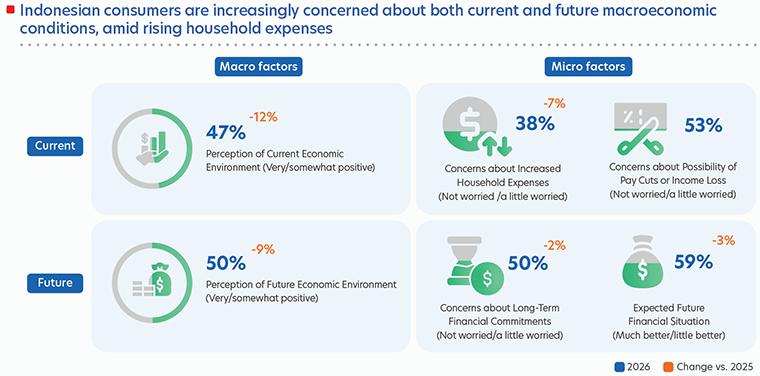
These findings are from UOB’s 2026 ASEAN Consumer Sentiment Study, which examines the financial attitudes, behaviours, and priorities of consumers across the region. In Indonesia, the results point to growing financial pressures and a more cautious approach to spending, saving, and investing, even as consumers increasingly embrace digital tools and new sources of financial information to manage their wealth.
Indonesian consumers are facing heightened economic anxieties, with the rising cost of living and geopolitical uncertainty emerging as their biggest concerns. The study found they are most concerned about the increased cost of living due to inflation (67 per cent), the global geopolitical environment (62 per cent), and rising household expenses (62 per cent). These concerns have increased significantly from the previous year and are higher than the regional averages.
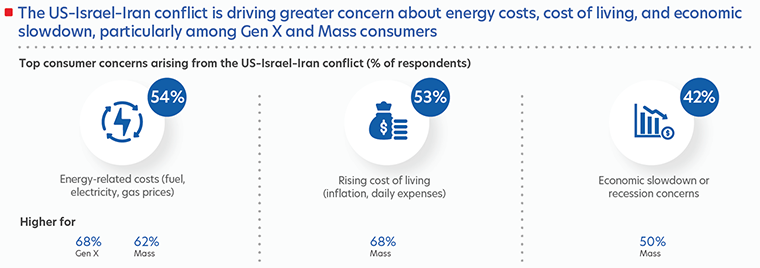
These sentiments reflect broader economic developments in Indonesia. Headline inflation rose to 3.28 per cent year-on-year in September 2026, up from 3.19 per cent the previous month, driven by higher prices for food, transportation, and personal care. Compared with consumers elsewhere in the region, Indonesians are also more concerned about energy-related costs and the risk of recession associated with the ongoing US-Israel-Iran conflict.
The impact of inflation is apparent in household finances. More than three-quarters (76 per cent) of Indonesian consumers say inflation has affected their purchasing power, a significant increase from 59 per cent in 2025 and higher than the regional average of 65 per cent. They are also more concerned about their ability to afford essential items (42 per cent), set aside money for savings (41 per cent), and pay utility bills (29 per cent) than they were a year ago.
In response, consumers are becoming more cautious with their spending. Nearly half (46 per cent) have delayed major expenses, while 42 per cent are spending less on non-essential items, and 36 per cent are tracking their expenses more carefully. These adjustments reflect how rising living costs are prompting households to reassess their spending priorities and exercise greater discipline over their finances.
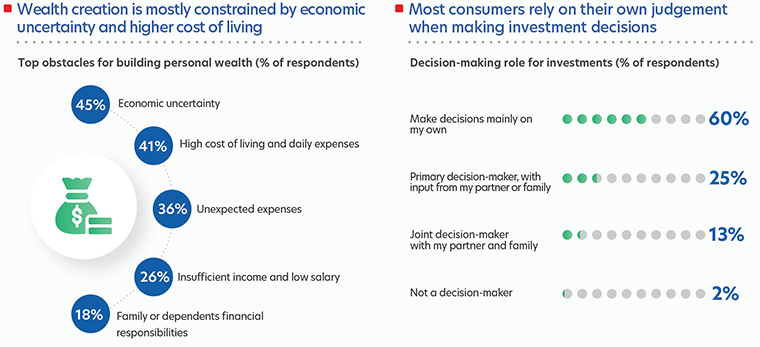
For Indonesian consumers, wealth extends beyond financial accumulation to encompass security, family well-being, and peace of mind. More than half (52 per cent) define financial freedom as being free from financial worries or debt, while 51 per cent associate it with being able to provide for their family's needs and future. Good health and physical well-being were cited by 39 per cent of respondents. However, economic uncertainty and unexpected expenses remain greater obstacles to building wealth among Indonesians than consumers elsewhere in the region.
Conversations about wealth and financial matters are relatively common, with 84 per cent of Indonesian consumers open to discussing wealth, compared with the regional average of 80 per cent. These discussions most frequently take place with spouses or partners (69 per cent), parents (39 per cent), and close friends (26 per cent).
These discussions extend to financial decisions, with more Indonesians making investment decisions with their partner or family (13 per cent) compared with the rest of the region (10 per cent). Meanwhile, 60 per cent make investment decisions independently, notably lower than the regional average of 69 per cent. Despite the importance of personal relationships in financial discussions, only one in five (23 per cent) engage with a financial advisor, compared with approximately one-third (32 per cent) of consumers regionally.
Digital tools are also becoming an integral part of how Indonesians manage their wealth, with 93 per cent using them for financial management. Their most common applications include planning financial goals (39 per cent), tracking income, spending, and cash flow (38 per cent), and monitoring investments or portfolio performance (33 per cent). Compared with consumers elsewhere in the region, Indonesians place greater importance on strong security and control over their personal data and account access (57 per cent), as well as the ease of buying and selling financial products (53 per cent).
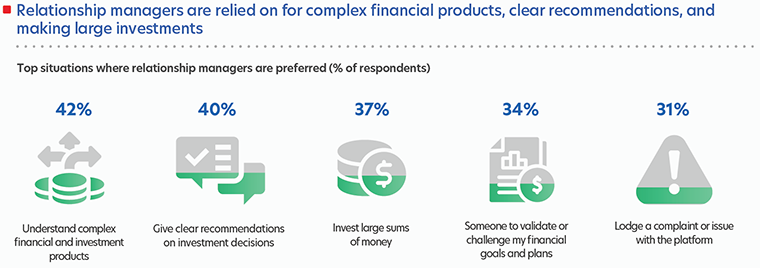
Nevertheless, digital adoption has not diminished the value of human financial advice. Only 8 per cent of Indonesian consumers believe they can rely entirely on digital tools for their financial needs. Many still prefer consulting a relationship manager when trying to understand complex financial products (42 per cent), seeking investment recommendations (40 per cent), or investing large sums of money (37 per cent).
The appeal of human advice lies in the personalised guidance and reassurance it provides. Some 38 per cent value relationship managers for their ability to tailor recommendations to their individual financial circumstances, while 35 per cent appreciate the trust and reassurance that digital tools cannot replace. Another 35 per cent value their support in making decisions during volatile or stressful market conditions. This suggests that while digital tools offer convenience and accessibility, human expertise continues to play an important role in helping consumers navigate more complex financial decisions.
Artificial intelligence (AI) is becoming an increasingly important source of financial information for Indonesian consumers. Respondents said they get their financial information from banks, search engines, and AI-powered tools equally at 44 per cent each. However, when it comes to trust, they turn to the usual suspects: banks (79 per cent), human financial advisors (71 per cent), or a peer, friend, or family member (66 per cent).
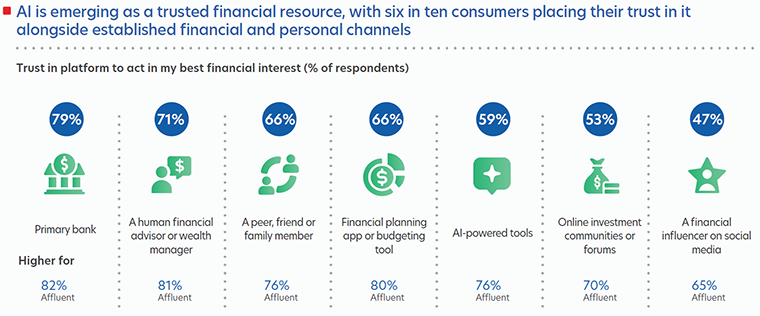
Despite this preference for established sources, Indonesian consumers have had encouraging experiences using AI for financial decisions. More than four in five have made financial decisions based on AI advice, with 77 per cent reporting positive outcomes. Although this is below the regional average of 83 per cent, a higher proportion of Indonesian consumers reported very positive outcomes (36 per cent), compared with 26 per cent regionally.
Consumers are using AI across several aspects of financial management. The most common application is comparing banking products (44 per cent), exceeding the regional average of 39 per cent. This is followed by understanding financial information or documents (39 per cent), and making budgeting, spending, and savings decisions (37 per cent), also higher than the regional average of 33 per cent.
These applications reflect consumers' growing interest in using AI to make everyday financial management more accessible and informed. When it comes to AI-powered banking features, half (50 per cent) value tools that help them avoid overspending, while 46 per cent appreciate features that encourage saving. Another 42 per cent value personalised product recommendations.
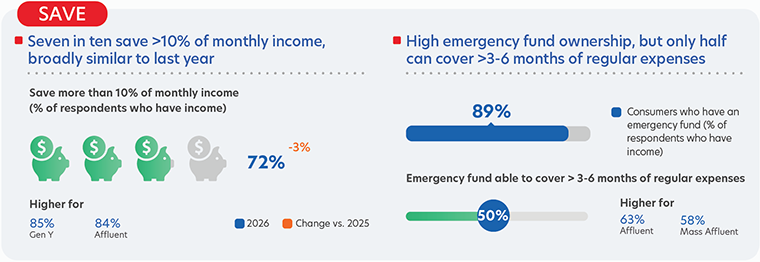
Despite mounting economic pressures, most Indonesian consumers remain confident in their ability to manage their personal finances. However, this confidence has softened, with 89 per cent feeling financially capable in 2026, down from 94 per cent in 2025, although still slightly above the regional average of 88 per cent.
Savings habits have also weakened slightly. Some 72 per cent of Indonesian consumers save at least 10 per cent of their personal income, compared with 75 per cent in the previous year and the regional average of 77 per cent. While 89 per cent have an emergency fund, one percentage point higher than in 2025, the proportion with more than seven months' worth of savings set aside has declined from 30 per cent to 24 per cent.
In terms of financial protection, more consumers have basic health insurance than in the previous year, with ownership increasing to 68 per cent from 62 per cent in 2025. However, ownership of life, term life, accidental, and critical illness insurance has declined. Meanwhile, approximately three in four Indonesian consumers spend up to 15 per cent of their annual salary on insurance premiums, indicating that insurance remains an important consideration in household financial planning.
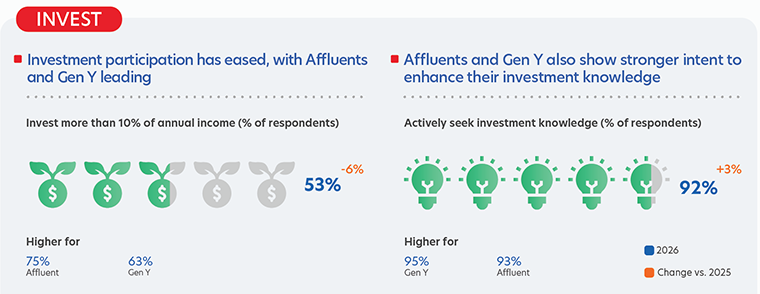
Investment behaviour is also becoming more conservative. The proportion of consumers investing more than 10 per cent of their annual income fell to 53 per cent, down from 59 per cent in 2025 and below the regional average of 58 per cent. Their appetite for higher-risk investments has similarly declined, with 37 per cent investing in high-risk, high-return products, compared with 48 per cent in the previous year and the regional average of 40 per cent.
Beyond immediate financial priorities, fewer consumers are also making plans for the longer term. The proportion undertaking some form of legacy planning declined from 75 per cent in 2025 to 66 per cent in 2026. This points to a broader shift towards prioritising immediate financial needs and maintaining greater financial flexibility amid an uncertain economic environment.
Indonesian consumers are navigating a more challenging financial environment, with rising inflation, increasing household expenses, and geopolitical uncertainty weighing on their economic outlook. These pressures are shaping their financial behaviours, prompting more cautious spending, lower savings and investment contributions, and a reduced appetite for investment risk.
Nevertheless, consumers remain actively engaged in managing their wealth and planning for their financial futures. Digital tools and AI are playing a growing role in helping them make financial decisions, while the continued importance of human advice highlights the need for financial institutions to offer both technological convenience and personalised support.
Understanding these evolving priorities is key to building stronger customer relationships and delivering relevant financial solutions. By recognising the challenges, expectations, and aspirations of Indonesian consumers, financial institutions can better support their financial well-being and long-term wealth goals.
Explore the full findings of UOB’s 2026 ASEAN Consumer Sentiment Study to discover how consumer attitudes towards wealth, savings, and financial decisions are evolving across Indonesia and the wider region.

The ASEAN Consumer Sentiment Study (ACSS) is UOB’s flagship regional survey, tracking consumer trends and sentiment across five key markets: Singapore, Malaysia, Thailand, Indonesia and Vietnam.
Now in its seventh year, the 2026 edition of the study was conducted in June and captures the views of 5,000 consumers, with 1,000 respondents from each country.
Key topics covered include:
This article shall not be copied or relied upon by any person for whatever purpose. This article is given on a general basis without obligation and is strictly for information only. The information contained in this article is based on certain assumptions, information and conditions available as at the date of the article and may be subject to change at any time without notice. You should consult your own professional advisers about the issues discussed in this article. Nothing in this article constitutes accounting, legal, regulatory, tax or other advice. This article is not intended as an offer, recommendation, solicitation, or advice to purchase or sell any investment product, securities or instruments. Although reasonable care has been taken to ensure the accuracy and objectivity of the information contained in this article, UOB and its employees make no representation or warranty, whether express or implied, as to its accuracy, completeness and objectivity and accept no responsibility or liability for any error, inaccuracy, omission or any consequence or any loss or damage howsoever suffered by any person arising from any reliance on the views expressed and the information in this article.
Get the ACSS 2026 Indonesia infographics. Download now


17 Nov 2026 • 6 MINS READ