You are now reading:
UOB Business Outlook Study 2026 (Regional) H1: How Energy, Supply Chains and AI are reshaping business growth

Find out how we can help you fast-track your investments in the JS-SEZ.
Learn more
you are in UOB ASEAN Insights


You are now reading:
UOB Business Outlook Study 2026 (Regional) H1: How Energy, Supply Chains and AI are reshaping business growth
Amid geopolitical uncertainty and rising costs, businesses across ASEAN and Greater China are accelerating investments in energy management, supply chain resilience and artificial intelligence (AI) to build operational foundations for competing in a volatile world. This is a key finding from the UOB Business Outlook Study 2026 (H1), which surveys small- and medium-sized enterprises (SMEs) in Singapore, Malaysia, Indonesia, and Thailand, and large enterprises in Singapore, Vietnam, China and Hong Kong.
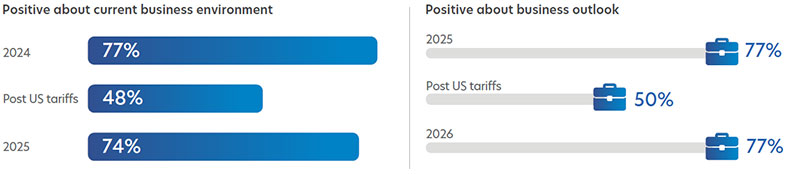
Our study finds that 74 per cent of businesses remain optimistic about the current environment. This confidence, though, comes with high pressure: rising operating costs affect 35 per cent of businesses, while manpower expenses and United States (US) tariff uncertainty each weigh on 26 per cent. Recovery is uneven across the region, with Indonesia and Vietnam leading in confidence and Singapore, Thailand and Hong Kong taking a more measured approach.
Rather than waiting for conditions to stabilise, businesses are taking action. They are turning cost pressures into capability-building. We introduce these priorities—energy management, supply chain resilience and AI adoption—as new pulse topics for 2026, along with the core themes of digitalisation, sustainability and overseas expansion.
This year’s study reveals that:
Energy efficiency has become an operational priority. Over eight in 10 businesses are treating energy management as a core pillar of sustainability. The trend is strongest in Vietnam, Indonesia, and Thailand.

Early sustainability efforts focused on branding and corporate reputation. But that logic has changed. Today, businesses value energy management for its ability to cut exposure to external volatility and improve cost structures.
The shift is visible as our data points to the main priorities gaining traction: reducing energy consumption and improving efficiency (47 per cent) and optimising energy usage through digital tools (42 per cent).
“Sustainability remains firmly on the agenda, even as momentum moderates amid macro uncertainty and concerns over energy and resource security. Many ASEAN businesses are recalibrating their approach, shifting focus from ambition to business impact, with energy efficiency emerging as a practical starting point to manage costs, strengthen energy resilience and stay competitive. We partner businesses with practical, fit-for-purpose sustainable finance approaches that help them understand, unlock and sustain the economic value of sustainability through cycles, supporting steady and credible long-term growth.”
Adrian Ow, Head of ESG Strategy, UOB
Despite barriers like high upfront costs, limited in-house expertise, and resource constraints, the intent to act is strong. There is growing interest in advanced solutions like renewable and clean energy, energy auditing and monitoring systems, and automated energy optimisation.
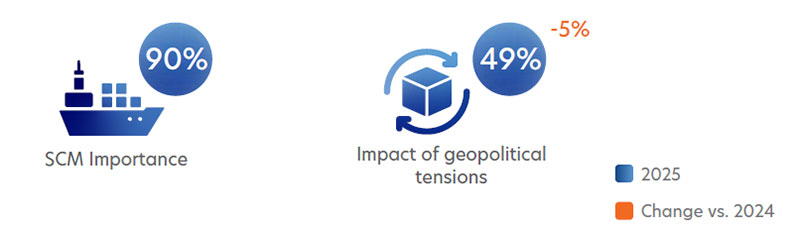
Supply chain management is a strategic priority for nine in 10 businesses, especially in Vietnam, Indonesia, and China. Although geopolitical disruptions have slightly decreased since 2024, manufacturing-heavy markets remain highly exposed.
Regulatory ambiguity is creating widespread operational challenges. Eighty-seven per cent of businesses are dealing with uncertainty about 'Local Content' and 'Country of Origin' regulations, particularly in Greater China markets. High input costs make compliance harder to achieve.
China continues as the region's main manufacturing hub of the world, but localisation is still limited. Only one in four ASEAN businesses achieves end-to-end local manufacturing. This reliance exposes companies to risk as trade policies change.
Businesses are rethinking supply chain strategies. Seven in 10 businesses plan to expand their supplier base to build resilience. ASEAN and Hong Kong businesses favour nearshoring, while China-based businesses are looking beyond the region.
The primary motivators are access to new markets (63 per cent), cost optimisation (57 per cent), and resilience to long-term disruptions (52 per cent). To get there, businesses are turning to ecosystem partnerships, digital supply chain management (SCM) solutions, and advisory support as key enablers.
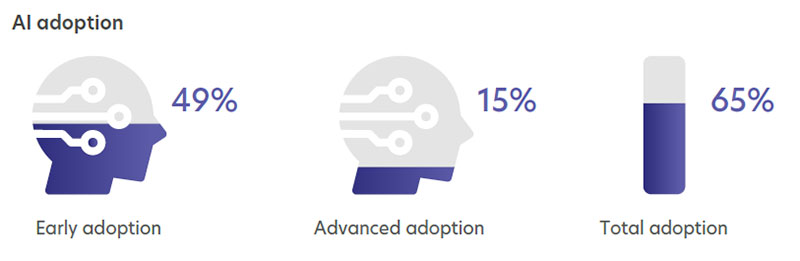
AI has moved from experimental to operational, though most businesses are still early in the journey. Sixty-five per cent of businesses have adopted AI in some capacity, but only 15 per cent have reached advanced capability levels.
For businesses implementing AI, their use cases are expanding into practical applications. For example, 39 per cent use it for customer support automation, while 34 per cent apply it to payments and invoicing. Expected ROIs from AI use include productivity gain (51 per cent), lower cost (49 per cent), and customer engagement (44 per cent).
Our survey identifies three challenges slowing the pace of progress: data and system readiness gaps (47 per cent), funding availability (47 per cent), and talent and capability shortfalls (39 per cent).
However, these obstacles do not deter ambition. Eighty-eight per cent of businesses plan to increase AI budgets in 2026. It’s a clear signal that AI is seen as a long-term competitive advantage, not a passing priority.
The expansion appetite remains strong. Close to 80 per cent of businesses are interested in regional or global growth, with intent strongest in Indonesia and Vietnam. Businesses are reducing dependence on single markets and looking to intra-ASEAN trade as a buffer against geopolitical and macroeconomic risk.
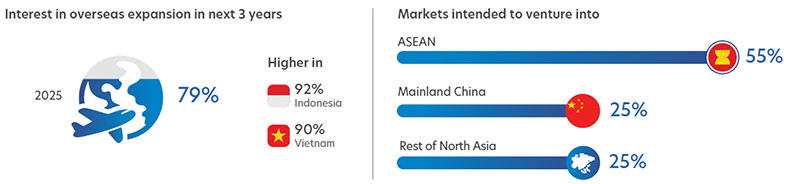
ASEAN is the top destination, cited by 55 per cent of respondents, followed by Mainland China and North Asia. Within ASEAN, Malaysia, Singapore, and Thailand are the most sought-after markets. For China-based companies, Malaysia is a key entry point for building an ASEAN presence.
“ASEAN is firmly in the spotlight as businesses prioritise the region as their primary growth market. This study notes that expansion across ASEAN is being driven by the pursuit of topline growth, closer access to customers and the need to de-risk supply chains. As this region emerges as a key FDI destination, businesses are committing significant capital as they position themselves closer to demand and build more diversified, resilient operating models.”
Sam Cheong, Head of Group FDI Advisory, UOB
Two in three businesses plan to pursue foreign direct investment (FDI), with an average planned investment of approximately US$21 million over 12 to 24 months. Supply chain de-risking and a China+1 strategy drive over half (53 per cent) of FDI decisions.
Key challenges for expansion include finding the right local partners, bridging market knowledge gaps and securing funding for cross-border operations.
Our findings confirm that digital transformation is now the norm. Eighty-six per cent of businesses have adopted digital solutions. However, only 61 per cent report successful implementation. This gap suggests that adoption alone does not guarantee results. Businesses reporting success have integrated digital solutions into core operations, trained their teams and aligned technology investments with business objectives.
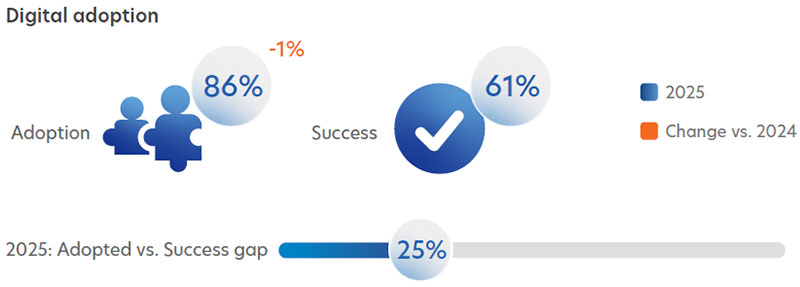
Where it works, the benefits are substantial—improved productivity (40 per cent), stronger business performance (36 per cent), and better data protection and security (31 per cent).
But as adoption deepens, so do the risks. Cybersecurity concerns have grown steadily and now sit alongside cost and capability gaps as primary constraints. Despite these pressures, close to eight in 10 businesses plan to raise digitalisation spending in 2026, led by Indonesia and Vietnam.
Energy management, supply chain resilience, and AI adoption are no longer separate initiatives. They reinforce one another and converge into a strategic framework as businesses in ASEAN and Greater China are transforming to grow through uncertainty.
At UOB, we support this transition with financing solutions, regional connectivity, digital tools, and advisory expertise. Contact us to find out more.

The UOB Business Outlook Study 2026 (SMEs & Large Enterprises) surveyed over 2,000 business owners and senior executives from various sectors across Indonesia, Malaysia, Singapore, Thailand, Vietnam, Mainland China and Hong Kong SAR. From 2026 onwards, the study shifts to a bi-annual cadence to better capture fast-changing geopolitical economic and business developments. Conducted online in January 2026 the study offers insights into:
The H1 2026 edition also introduces three new Pulse Topics, offering deeper insights into emerging business priorities:
This article shall not be copied or relied upon by any person for whatever purpose. This article is given on a general basis without obligation and is strictly for information only. The information contained in this article is based on certain assumptions, information and conditions available as at the date of the article and may be subject to change at any time without notice. You should consult your own professional advisers about the issues discussed in this article. Nothing in this article constitutes accounting, legal, regulatory, tax or other advice. This article is not intended as an offer, recommendation, solicitation, or advice to purchase or sell any investment product, securities or instruments. Although reasonable care has been taken to ensure the accuracy and objectivity of the information contained in this article, UOB and its employees make no representation or warranty, whether express or implied, as to its accuracy, completeness and objectivity and accept no responsibility or liability for any error, inaccuracy, omission or any consequence or any loss or damage howsoever suffered by any person arising from any reliance on the views expressed and the information in this article.


17 Mar 2026 • 5 MINS READ

09 Dec 2025 • 5 mins read
Get the full UOB Business Outlook Study 2026 (Regional). Download now