You are now reading:
ASEAN Consumer Sentiment Study 2025 (Thailand): Economic optimism dampened by cost concerns
Discover how their spending and financial habits are changing with insights from UOB’s consumer confidence barometer.

Find out how we can help you fast-track your investments in the JS-SEZ.
Learn moreyou are in UOB ASEAN Insights


You are now reading:
ASEAN Consumer Sentiment Study 2025 (Thailand): Economic optimism dampened by cost concerns
In the Land of Smiles, consumer positivity and confidence are taking a hit. Despite a slight growth in optimism about the economic environment from the previous year, consumer sentiment in Thailand is lower than that of its ASEAN neighbours. This outlook is reflected in shifting trends in financial preparedness, spending habits, and budget priorities, based on in-depth insights presented in the UOB ASEAN Consumer Sentiment Study 2025 (Thailand).
Tempered enthusiasm is likely to continue in 2026: Thailand’s National Economic and Social Development Council has projected that the Thai economy will grow by a modest 1.2 per cent to 2.2 per cent in 2026. Despite fiscal stimulus packages intended to lift household spending, the economy is likely to slow further in 2026 due to US tariffs, natural disasters, and possible political disruptions related to upcoming general elections.
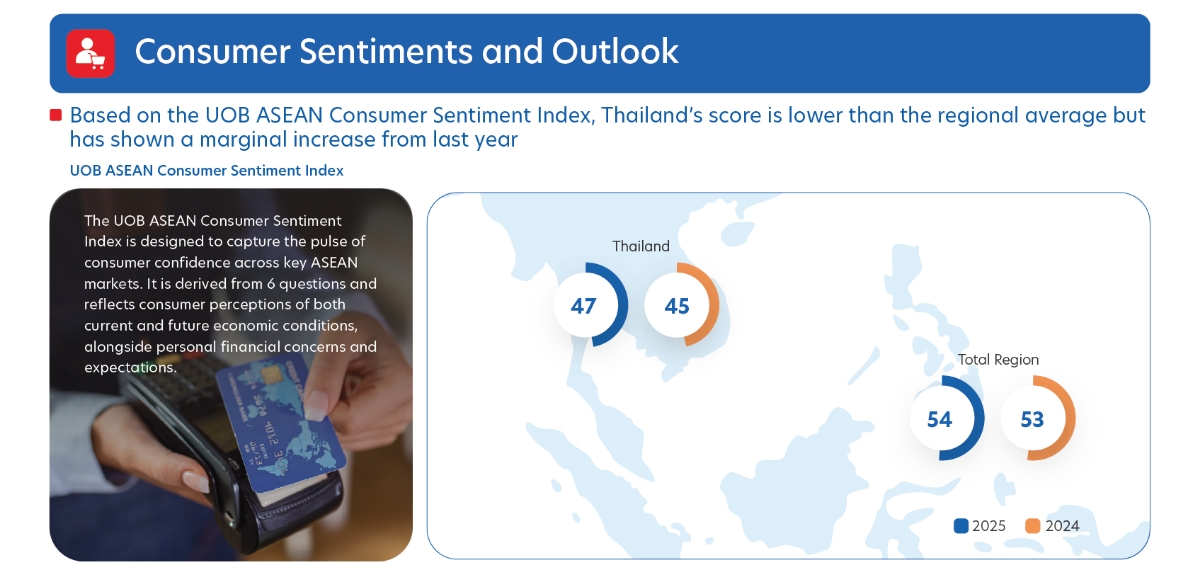
In 2025—much like in 2024—Thailand’s UOB Consumer Sentiment Index score (47 in 2025) remained lower than the regional average (54 in 2025). Inflation may have slowed slightly, and its score may have risen marginally by two points, but economic and structural concerns have not abated. One Gen X1 respondent summarised the mood: “The economy is in recession, population income is declining, and the price of goods is increasing.”

Figure 1: Thailand’s consumer sentiment score is lower than the regional average
Overall, Thai consumers hold a cautious outlook on economic, political, and social stability. This sentiment was further validated by recent events, including a political crisis that sparked an ongoing border conflict between Cambodia and Thailand. This has contributed to supply chain disruptions that have forced regional and local businesses to pivot and, in some cases, seek out new verticals or suppliers.
For consumers, these adjustments translate into greater uncertainty around prices, availability, and future costs. Compared with 2024, more Thai consumers are worried about their ability to save, maintain their current lifestyle, and put aside money for insurance.
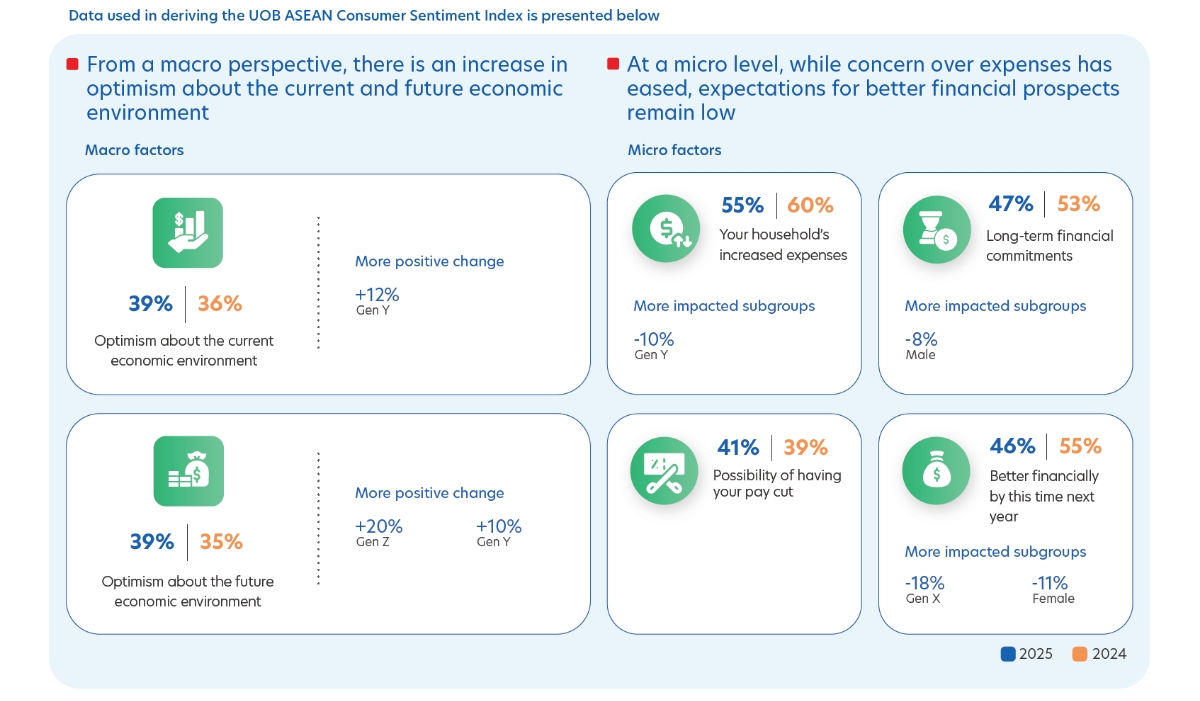
Despite these pressures, financial anxiety appears to have eased slightly. Compared with 2024, the number of respondents feeling worried over declining savings or wealth fell by 7 percentage points (but remains slightly higher than the regional average). The same trend is reflected for other concerns like increased household expenses (-5 percentage points) and increased cost of living due to inflation (-3 percentage points).

Figure 2: Top concerns expressed by Thai consumers
Finances, especially the rising cost of living, topped Thai consumers’ list of worries in 2025, followed by environmental concerns. The latter also reinforces the former. For instance, recent extreme weather events are weighing heavily on the populace — destroying homes, wiping out crops, causing factory shutdowns, and reducing tourism. In November 2025, severe flooding in Southern Thailand affected over two million people, while earlier in the year, in August 2025, flooding also impacted five northern provinces. The resulting disruption in the supply chain caused price spikes for various goods and services, from rice to insurance.
Given these pressures, 66 per cent of Thai consumers report spending less, and with more caution — a share that is 9 percentage points higher than the regional average. By contrast, only 15 per cent feel they are benefiting from better discounts or deals, or experiencing increased purchasing power.
Changes in spending habits include spending less on non-essential items, delaying big-expense events, and tracking expenses more closely.
Almost one in two consumers reported buying more products on sale (49 per cent) and taking more time to decide on new purchases (47 per cent). Compared with their counterparts in other countries, Thai consumers are more likely to view the current environment as a bad or very bad time to make a major purchase.

Figure 3: How Thais are dealing with inflation
Among those who continue to shop, payment preferences highlight a clear inclination towards familiar, trusted methods. Consumers in Thailand prefer to pay for purchases using cash, e-wallets or scan-to-pay tools, alongside relatively low mobile banking activity and limited use of mobile wallet credit or debit cards.
A higher proportion of respondents use cash in Thailand (66 per cent) compared with the regional average (61 per cent) and compared with 2024 (57 per cent), underscoring its continued relevance despite the growth of digital options. Buy Now Pay Later (BNPL) solutions are also rising in popularity, with 19 per cent of respondents saying they have used it in the past year (compared with 16 per cent across the region and 14 per cent in 2024).
In contrast, payment through e-commerce platforms significantly dropped compared with 2024 (39 per cent vs 34 per cent). Thai consumers’ use of physical debit cards also lags far behind the regional average (11 per cent vs 24 per cent).
The picture changes when Thais travel overseas — physical credit cards are the top preferred method. Cash is the second most preferred method, as respondents say it helps them avoid foreign transaction fees, control their spending, and reduce fraud risk.

Figure 4: Preferred payment modes during overseas trips
Beyond transactions, attitudes toward financial decision-making are influenced by trust and social dynamics. Thai consumers report high levels of trust in insurance agents and advisors, while also feeling relatively high pressure from social expectations or peer influences to spend more.
Thai households are becoming more deliberate in saving and preparing for financial shocks, even as longer-term planning remains a priority. The share of consumers with an emergency fund fell from 92 per cent to 83 per cent: more Thai consumers now report having no emergency fund at all, up 6 percentage points compared with 2024. In terms of regular savings, nearly seven in ten Thai consumers save more than 10 per cent of their monthly income, up five percentage points compared with 2024.
At the same time, insurance and investment behaviours are shifting. Coverage for basic health insurance and auto insurance dropped by 12 and 11 percentage points respectively, although Thailand still records the highest overall insurance penetration rate in the region.
Many Thai consumers are actively investing to weather financial uncertainty: 56 per cent of respondents have invested more than 10 per cent of their annual income, while the proportion who did not invest fell by 9 percentage points. Compared with the rest of ASEAN, Thai consumers are more inclined towards high-risk, high-return investments (6 percentage points above the regional average).
Looking further ahead, retirement remains a key concern. An overwhelming majority of Thai consumers (95 per cent) hope to either retain or improve their current lifestyle after retirement, with most aspiring to improve it.
Almost one in two Thai consumers say they have a fair idea of how much they will need to retire comfortably, and only 31 per cent feel that retirement is still a long way off. This has manifested in more active legacy planning: compared with 2024, more respondents made a will or designated a power of attorney (+11 percentage points and 6 percentage points respectively).

Figure 5: Most Thais are confident of improving or keeping their current lifestyles post-retirement
As Thai consumers adapt to economic uncertainty through proactive investing and more cautious spending, opportunities emerge for businesses that can meet these shifting needs.
No matter your market, UOB's financial expertise, wide footprint across ASEAN and deep understanding of regional consumer behaviour can help guide your growth strategy. Through accessible business funding and our ASEAN connectivity, we support businesses looking to navigate market complexities. Contact us to find out how.
1ACSS broadly categorises respondents into four age groups, namely Generation Z (18 to 26 years old), Generation Y (27 to 42 years old), Generation X (43 to 58 years old) and Baby Boomers (59 to 65 years old).
The ASEAN Consumer Sentiment Study (ACSS) is UOB’s flagship regional survey, tracking consumer trends and sentiment across five key markets: Singapore, Malaysia, Thailand, Indonesia and Vietnam.
Now in its sixth year, the 2025 edition of the study was conducted in June and captures the views of 5,000 consumers, with 1,000 respondents from each country, providing a consistent and comparative view of sentiment across the region.
Key topics covered include:
This article shall not be copied or relied upon by any person for whatever purpose. This article is given on a general basis without obligation and is strictly for information only. The information contained in this article is based on certain assumptions, information and conditions available as at the date of the article and may be subject to change at any time without notice. You should consult your own professional advisers about the issues discussed in this article. Nothing in this article constitutes accounting, legal, regulatory, tax or other advice. This article is not intended as an offer, recommendation, solicitation, or advice to purchase or sell any investment product, securities or instruments. Although reasonable care has been taken to ensure the accuracy and objectivity of the information contained in this article, UOB and its employees make no representation or warranty, whether express or implied, as to its accuracy, completeness and objectivity and accept no responsibility or liability for any error, inaccuracy, omission or any consequence or any loss or damage howsoever suffered by any person arising from any reliance on the views expressed and the information in this article.

17 Mar 2026 • 5 MINS READ

09 Dec 2025 • 5 mins read
Get the ACSS 2025 Thailand infographics.Download now