You are now reading:
ASEAN Consumer Sentiment Study 2025 (Singapore): Rising cost of living dampens consumer mood
Discover how their spending and financial habits are changing with insights from UOB’s consumer confidence barometer.

Find out how we can help you fast-track your investments in the JS-SEZ.
Learn moreyou are in UOB ASEAN Insights


You are now reading:
ASEAN Consumer Sentiment Study 2025 (Singapore): Rising cost of living dampens consumer mood
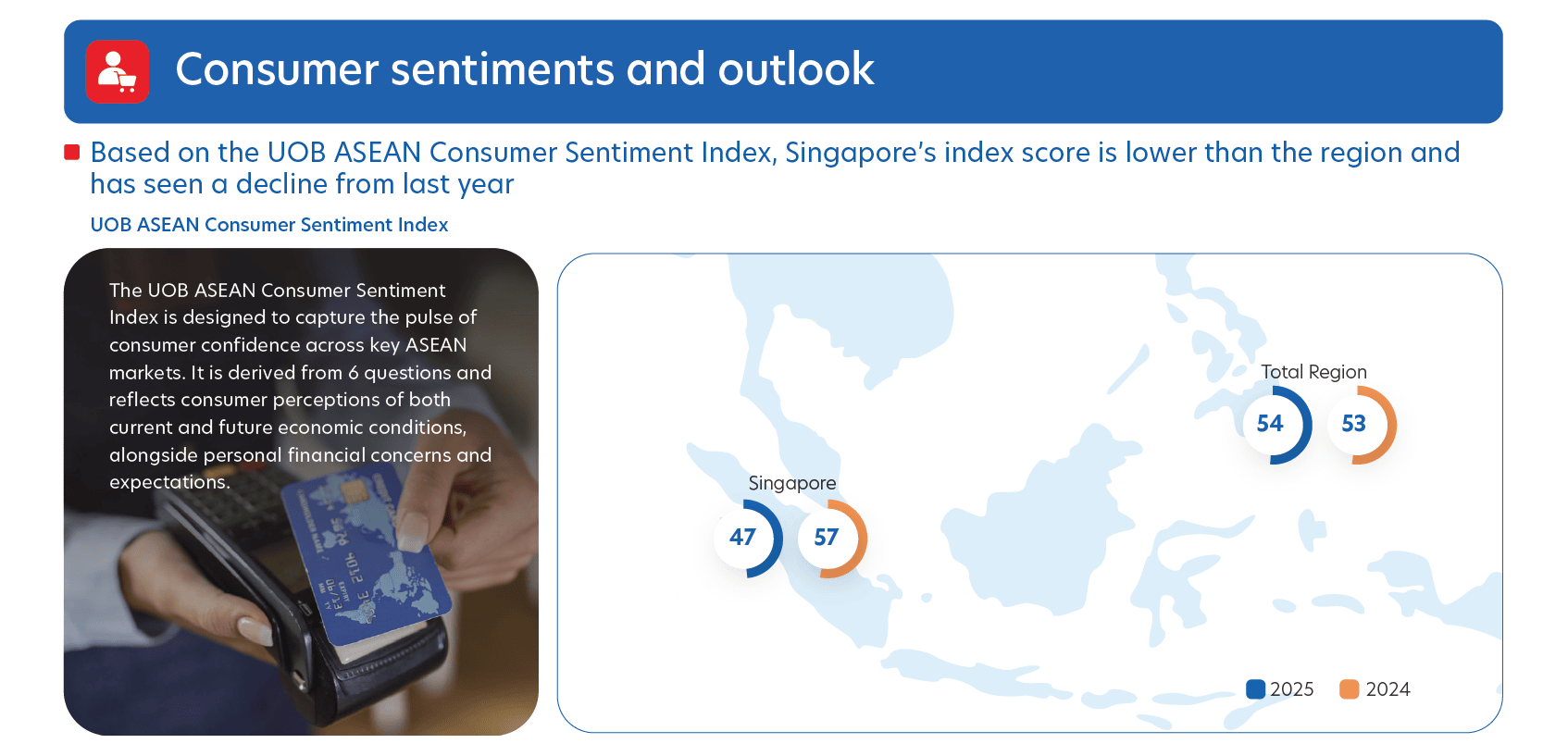
The Singapore market today presents a paradox. Despite feeling positive about their country’s political and social stability, consumers are increasingly concerned about the erosion of personal purchasing power. In the UOB ASEAN Consumer Sentiment Study 2025, Singaporean consumers reported waning confidence in their ability to maintain their lifestyle, save adequately, and retire comfortably.
In fact, among the countries studied, Singapore has among the lowest consumer sentiment at 47 per cent (tied with Thailand and topping Indonesia, Malaysia, and Vietnam). It also has the most pessimistic financial outlook—only 70 per cent expect to be better off or have the same financial status next year, compared with 92 per cent in Vietnam.
This apprehension reflects broader regional dynamics. As a UOB commentary notes, ASEAN is at an inflection point where “the era of stable geopolitics, predictable trade, and seamless supply chains is behind us.”
With Singapore’s role as a regional financial and trading hub, its residents are acutely sensitive to the global shift from certainty to volatility.
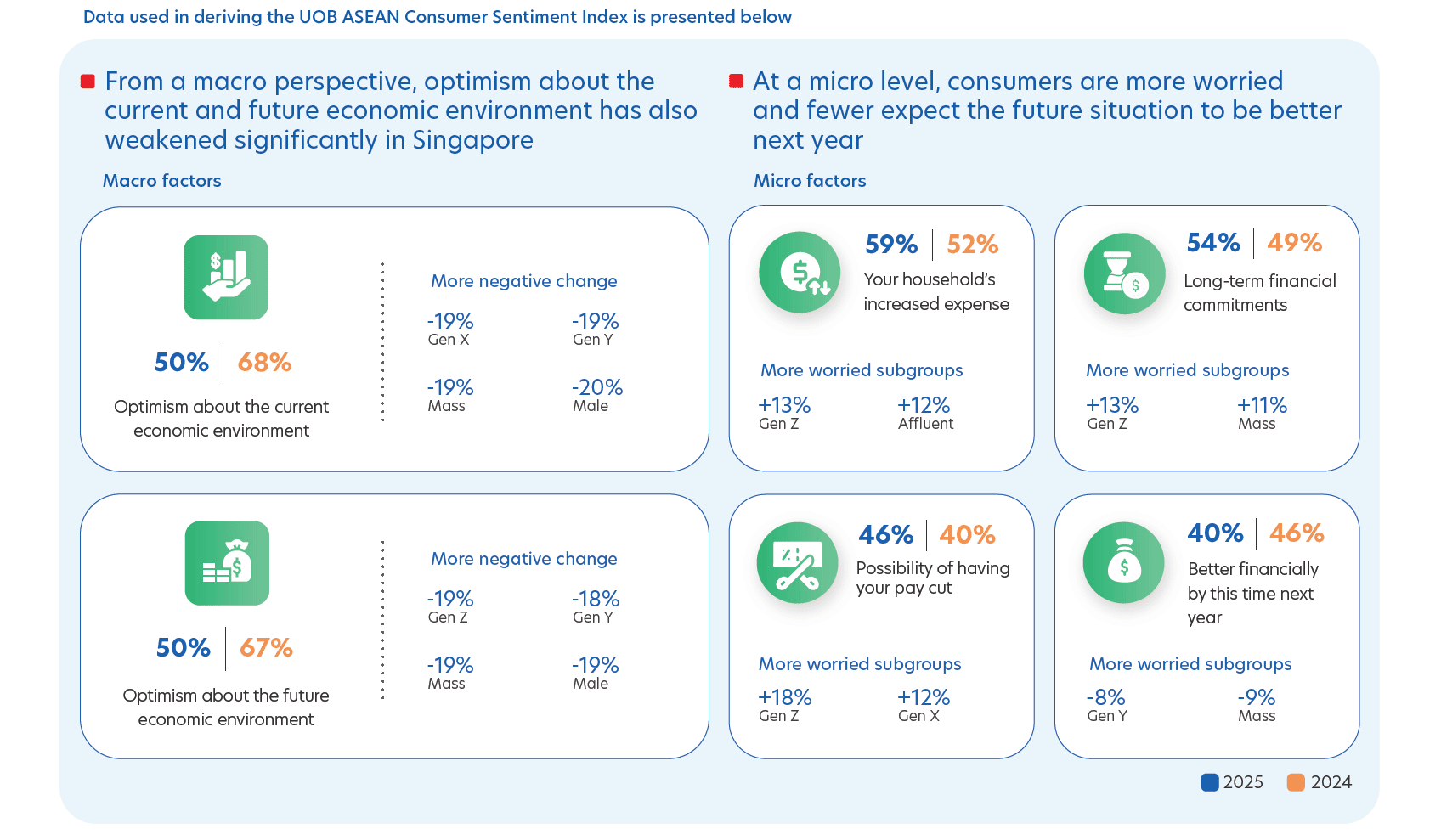
Singapore consumers report the greatest concern regionally about the cost of living due to inflation (66 per cent) and increased household expenses (59 per cent). Nearly two-thirds of those surveyed anticipate reduced purchasing power from inflation.

Figure 1: Consumers in Singapore are feeling the pinch from increasing costs and expenses
In response to economic pressure, Singapore consumers have shifted buying behaviours:
Moreover, only 26 per cent of Singaporeans believe now is a good time for major purchases. This is the lowest share of the population in the region and well below the regional average of 39 per cent.

Figure 2: More Singaporeans engaged in bargain-hunting to cope with rising costs
The price pressure is impacting how Singaporeans view financial management. Only 78 per cent feel confident that they can manage their personal finances effectively, compared with the regional average of 88 per cent. While nearly nine in ten Singaporeans (88 per cent) report having an emergency fund, this figure is down 4 percentage points from the previous year. Investment rates are also dropping: only 47 per cent of Singapore consumers are investing more than 10 per cent of their income (down from 59 per cent in 2024).
Among regional peers, fewer Singaporeans save at least 10 per cent of their monthly income; only 70 per cent of Singaporeans save more than 10 per cent of their income, compared with 74 per cent in the region.
However, those who do save tend to save more. Singapore has the largest share of consumers who save more than 30 per cent of their monthly income (18 per cent vs the regional average of 12 per cent). The next biggest savers—Vietnamese and Indonesians—are 6 percentage points behind.
Another paradox exists. Despite being one of the world's most technologically advanced nations with sophisticated digital infrastructure, 63 per cent of Singaporeans still use cash in their regular transactions.
More striking: when traveling overseas, 51 per cent of Singaporeans prefer cash as their payment method—the highest in the entire ASEAN region and significantly above Indonesia (29 per cent), Thailand (31 per cent), and Vietnam (22 per cent).

Figure 3: Cash remains the preferred mode of payment when on holiday overseas
Singaporean travellers report various reasons for this preference. The availability of 0% foreign exchange services helps facilitate the use of local currencies. However, the predominant reasoning (66 per cent) is "for ease of buying at small vendors". Forty-eight per cent of Singaporeans also use cash to avoid foreign transaction fees on card purchases, which can quickly add up. Other reasons include better budget control (42 per cent) and as a backup in case of card failure (41 per cent).
These reasons for cash preference cluster around a common theme: certainty and control in uncertain environments.
Interestingly, Singapore's 43 per cent e-wallet usage is the lowest in ASEAN, dramatically lagging behind Indonesia (74 per cent), Vietnam (62 per cent), and Thailand (61 per cent). The reason may lie in the maturity of the Singapore financial market. Singaporeans have many other payment options that are already widely accepted. Physical credit cards see 52 per cent usage, which is the highest in the region. Moreover, Scan-to-pay via PayNow is integrated directly into banking apps, used by 56 per cent of respondents. There are also mobile banking apps that enable seamless transactions (44 per cent usage) and physical debit cards (43 per cent).
Thus, in Singapore, mobile e-wallets don’t provide strong value-add to replace other well-established payment modes. Unlike in Indonesia or Vietnam, where e-wallets filled a gap in banking access and digital payment infrastructure, Singapore consumers already have multiple convenient digital options.
Financial pressures are reshaping how Singaporeans view their future—from insurance coverage to retirement plans.
Singaporeans have the advantage of being among the most highly insured populations in the region. Insurance coverage is declining, though—a potential indicator of trade-offs being made amidst financial challenges.
With the macroeconomic concerns, Singaporeans now also seem to hold a murkier picture of their retirement. Only 58 per cent of consumers have a clear idea of how much they need to retire comfortably. This is the lowest reported number in the region, down 11 percentage points from 2024. More than two in ten Singaporeans (21 per cent) expect to work past age 66, also the largest share in the region. This expectation of later retirement appears to reflect recognition of ever-rising costs and broader economic uncertainty.
Looking even further ahead, more than a third (35 per cent) of Singaporeans have not done any form of legacy planning. This is the highest proportion in the region.

Figure 4: Just over one in two Singaporeans have made a CPF nomination
The 2025 ASEAN Consumer Sentiment Study for Singapore reveals a cautious populace that seeks value. Immediate discretionary spending remains subdued due to global economic uncertainty and domestic inflation concerns.
For Singaporeans, the focus appears to be on "value" and "control." To engage cautious consumers, businesses might consider demonstrating clear, tangible value that justifies the purchase. Moving beyond generic promotions could persuade buyers to cash in. Solutions that aid in financial management and budgeting (e.g. clear instalment plans, bundled services, or loyalty programs that offer calculable savings) may also prove effective in winning buyers over.
To see the actual numbers behind this commentary, download the full report. To find out how we can help businesses expand within ASEAN and beyond, please get in touch. If you’d like to see how your financial health stacks up against other Singapore consumers, take the quiz.
The ASEAN Consumer Sentiment Study (ACSS) is UOB’s flagship regional survey, tracking consumer trends and sentiment across five key markets: Singapore, Malaysia, Thailand, Indonesia and Vietnam.
Now in its sixth year, the 2025 edition of the study was conducted in June and captures the views of 5,000 consumers, with 1,000 respondents from each country, providing a consistent and comparative view of sentiment across the region.
Key topics covered include:
This article shall not be copied or relied upon by any person for whatever purpose. This article is given on a general basis without obligation and is strictly for information only. The information contained in this article is based on certain assumptions, information and conditions available as at the date of the article and may be subject to change at any time without notice. You should consult your own professional advisers about the issues discussed in this article. Nothing in this article constitutes accounting, legal, regulatory, tax or other advice. This article is not intended as an offer, recommendation, solicitation, or advice to purchase or sell any investment product, securities or instruments. Although reasonable care has been taken to ensure the accuracy and objectivity of the information contained in this article, UOB and its employees make no representation or warranty, whether express or implied, as to its accuracy, completeness and objectivity and accept no responsibility or liability for any error, inaccuracy, omission or any consequence or any loss or damage howsoever suffered by any person arising from any reliance on the views expressed and the information in this article.

17 Mar 2026 • 5 MINS READ

09 Dec 2025 • 5 mins read
Get the ACSS 2025 Singapore infographics. Download now