You are now reading:
UOB Business Outlook Study 2026 (China) H2: China businesses balance growth ambitions with rising geopolitical and cost pressures

Find out how we can help you fast-track your investments in the JS-SEZ.
Learn more
you are in UOB ASEAN Insights


You are now reading:
UOB Business Outlook Study 2026 (China) H2: China businesses balance growth ambitions with rising geopolitical and cost pressures
China businesses are more optimistic in H2 2026, but rising costs and geopolitical uncertainty continue to weigh on decisions. Businesses are accelerating AI adoption, sharpening digital investments, strengthening supply chains and pursuing overseas growth, while balancing sustainability ambitions with near-term commercial pressures.
Business sentiment in China strengthened significantly in H2 2026, with 93% of businesses positive about the current business environment, up from 78% in H1. Tech, Media & Telecom and Large Enterprises are among the most optimistic segments.
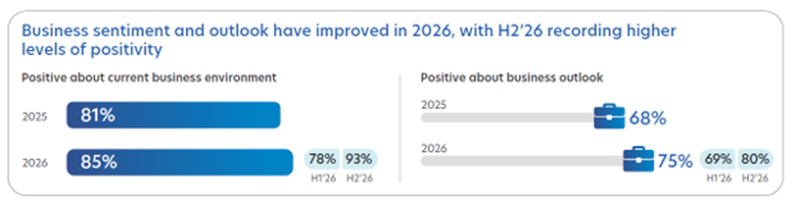
The outlook has also improved, with 80% expecting better business performance in H2, compared with 69% in H1. However, optimism remains uneven as most businesses expect only modest growth and not vast improvement. Businesses in Tech, Media & Telecom are more optimistic than those in Construction & Infrastructure and the Rest of Mainland China.
Geopolitical tensions have risen from 21% in H1 to 29% in H2, although concerns about US tariffs have eased from 28% to 22%. Rising operational costs remain the leading macroeconomic concern.
Stronger networks are the leading strategic enabler identified by businesses (46%), ahead of resilient supply chains (26%) and simpler operations (25%).
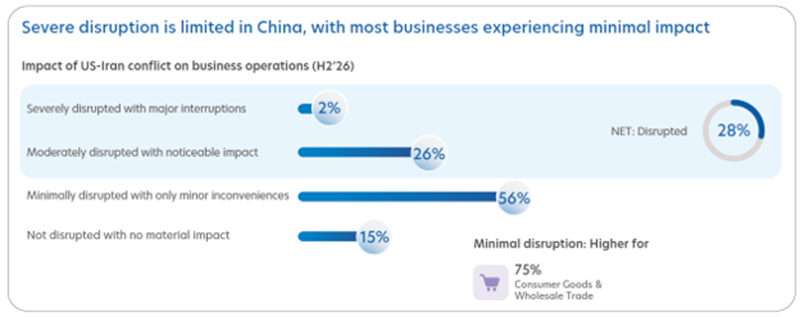
The direct operational impact of the US-Iran conflict has been relatively contained in China, with 28% of businesses reporting moderate-to-severe disruption, compared with the regional average of 52%.
However, the cost implications are more widespread, with 85% reporting an increase in their cost base due to higher energy prices and supply-chain disruptions. Manufacturing, Engineering & Industrials businesses, Medium Enterprises and businesses in Beijing face a greater cost burden, reflecting their exposure to energy, materials and supply-chain costs. Rising energy and raw material prices have also contributed to producer-price inflation.
Businesses are responding by strengthening cybersecurity and digital infrastructure resilience (52%) and diversifying or nearshoring supply chains away from the Gulf region (46%). Large Enterprises are particularly active in supply-chain diversification, while Medium Enterprises have paused capital expenditure plans.
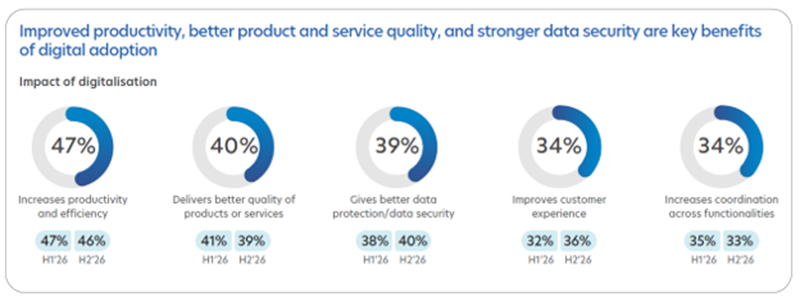
Digitalisation is delivering measurable benefits, with nearly one in two businesses reporting productivity gains, while around two in five cite improvements in product and service quality and data protection and security. Manufacturing and Engineering businesses are leveraging digitalisation to improve productivity, while Construction & Infrastructure businesses use it to enhance product and service quality.
However, success remains uneven. Half of businesses trialling or adopting digitalisation reported great or considerable success in H2, while full-year findings show a 17-percentage-point success gap between Large and Medium Enterprises.
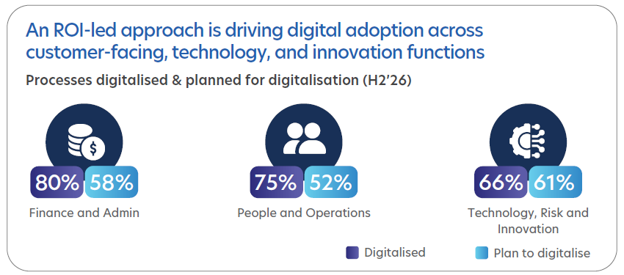
Implementation costs, skills shortages and cybersecurity remain key barriers for adopting digitalisation. Although digital investment remains resilient, businesses are moderating budget growth and shifting from broad-based transformation towards more targeted, return-on-investment-led spending. Sales, marketing and customer functions are receiving attention alongside technology, security and innovation.
Blockchain and distributed ledger technology are also emerging as the next digital frontier, with 68% of businesses piloting or planning adoption over the next six to 12 months. Larger businesses and those in Construction & Real Estate are likely to see stronger adoption. Among current users, around four in five report benefits in operational efficiency and speed of operations.
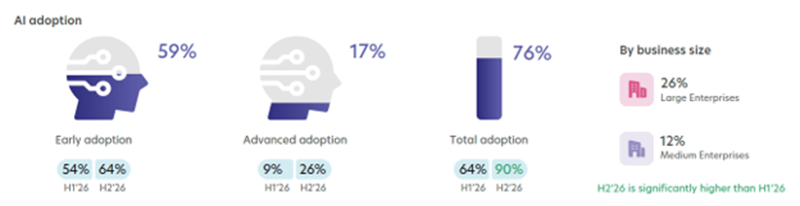
AI adoption accelerated sharply in H2, reaching 90% of businesses, up from 64% in H1. Advanced adoption also increased, from 9% to 26%. Large Enterprises, businesses in Shenzhen and those in Tech, Media & Telecom lead adoption, likely reflecting their access to funding and skilled resources. Construction & Infrastructure, Healthcare & Medical Services and Medium Enterprises lag in advanced adoption.
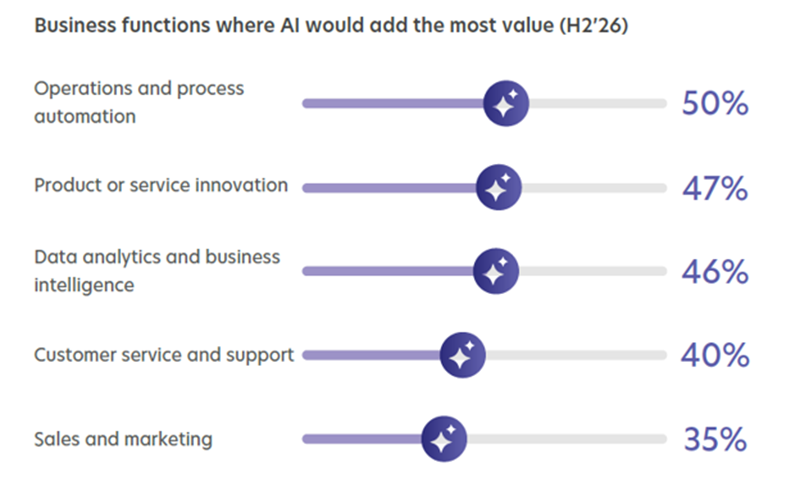
Businesses see the greatest value in operations and process automation (50%), product and service innovation (47%) and data analytics and business intelligence (46%). Manufacturers, in particular, are placing greater emphasis on process automation and supply-chain applications.
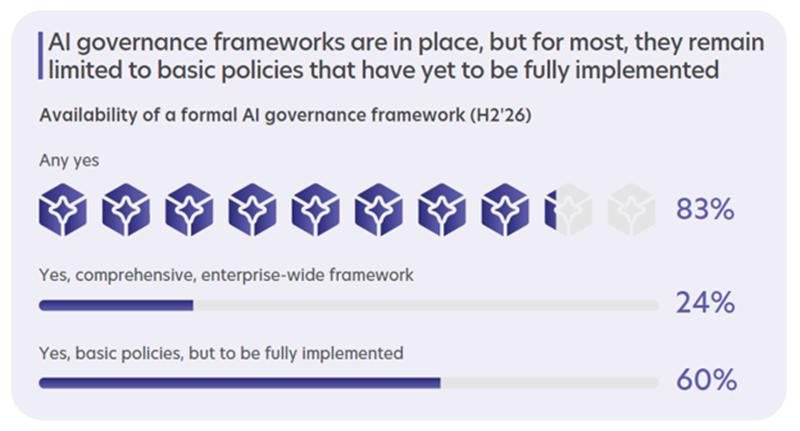
Governance and workforce readiness remain important considerations. While 83% have some form of AI governance framework, most have basic policies rather than fully implemented, enterprise-wide frameworks. Medium Enterprises and businesses in Consumer Goods & Wholesale Trade show weaker AI governance compared to other industries.
Businesses are taking a human-centred approach to AI transformation, prioritising job redesign (46%) and employee upskilling and reskilling (27%) over external AI hiring (20%). Agentic AI is also gaining traction, with 48% having deployed multi-agent systems or actively piloting or planning deployment. AI investment remains resilient, with 89% planning to increase budgets.

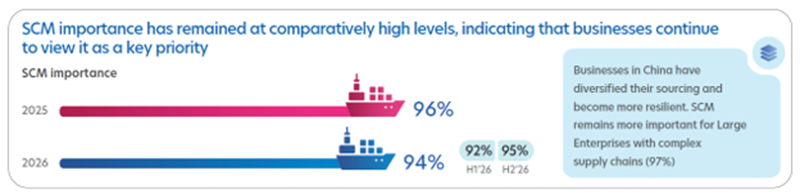
Supply-chain management remains a priority, with 95% of businesses considering it important. The proportion highly affected by geopolitical events rose modestly from 47% in H1 to 53% in H2. Businesses in China have diversified their sourcing and strengthened resilience, while Large Enterprises with more complex supply chains place greater importance on supply-chain management.
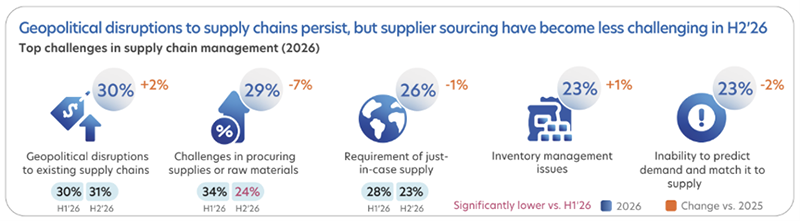
Geopolitical disruptions (30%) and difficulties procuring supplies and raw materials (29%) remain the leading challenges, although procurement concerns have eased compared with 2025.
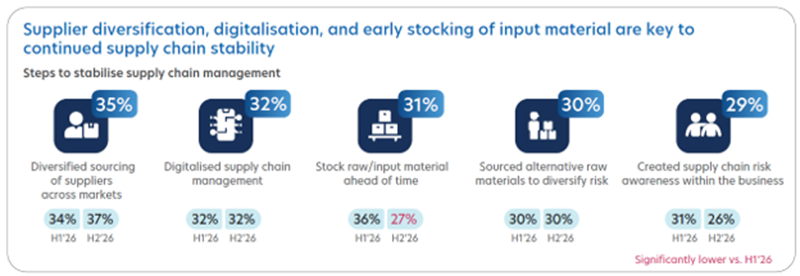
Businesses are building resilience through supplier diversification (35%), supply-chain digitalisation (32%) and early stocking of input materials (31%). Domestic markets remain central, with 81% sourcing domestically and 78% serving domestic end customers. ASEAN is the next key sourcing and customer market.
Supply-chain financing and trade credit insurance, both cited by 38%, are the most relevant trade-financing solutions. These can help businesses manage higher input costs and reduce payment-default risks amid continued geopolitical and trade uncertainty.
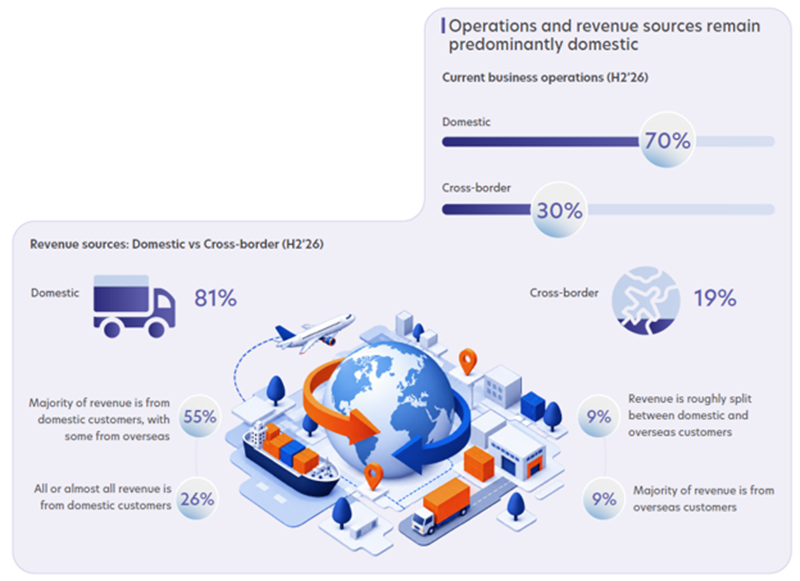
China businesses remain predominantly domestic in their operations, with 70% operating domestically and 30% cross-border. Revenue is similarly concentrated at home, with 81% deriving most of it from domestic customers.
External partnerships nevertheless offer opportunities to access new capabilities and markets. Some 63% of businesses consider them important for growth, particularly for supply-chain and sourcing needs (40%) and technology and innovation (35%).
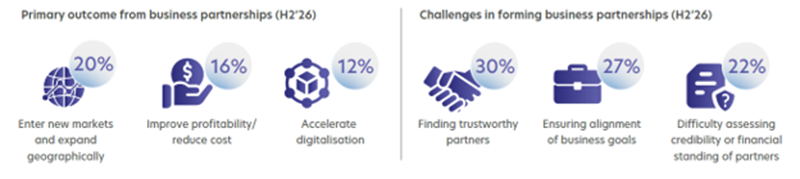
Finding trustworthy partners is the leading partnership challenge (30%), followed by aligning business goals (27%). This highlights the importance of trust and relationship-building in business collaboration. In China, established business relationships, or guanxi, can help companies build trust, exchange information and coordinate activities across supply chains. For SMEs facing resource constraints and market uncertainty, these networks can support access to resources and strengthen supply-chain resilience. The value lies in developing reliable, mutually beneficial business relationships.
Businesses primarily seek partnerships to enter new markets and expand geographically (20%), followed by improving profitability and reducing costs (16%). Their financing needs depend on these objectives. Among businesses pursuing geographic expansion, 68% identify funding for setting up in new markets as their leading requirement, while working-capital financing matters to those focused on revenue growth.
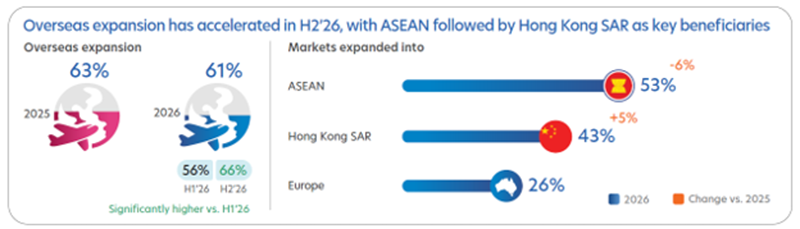
Overseas expansion accelerated in H2, with 66% of businesses expanding overseas, up from 56% in H1. Interest in future expansion remains high, with 87% interested in expanding overseas. ASEAN continues to be the leading destination, with Malaysia, Singapore and Thailand the top markets among businesses planning ASEAN expansion over the next three years.
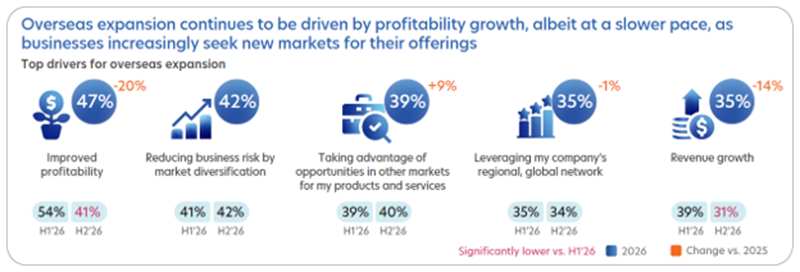
Businesses are increasingly motivated by risk diversification and opportunities in other markets, alongside profitability. However, limited customer access, difficulty finding suitable partners and insufficient in-house expertise remain barriers.
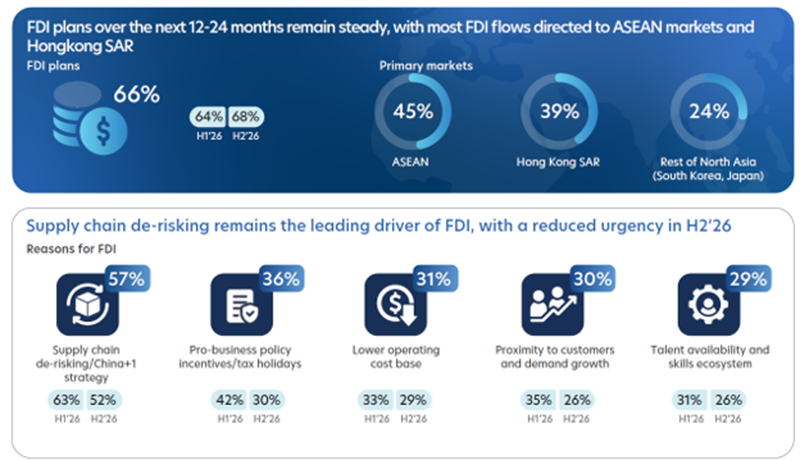
Foreign direct investment plans are also steady, with 68% likely to invest overseas in the next 12 to 24 months, compared with 64% in H1. ASEAN attracts the largest share of intended investment. Supply-chain de-risking and the China+1 strategy remain the leading FDI drivers (52%), alongside pro-business incentives and lower operating costs.
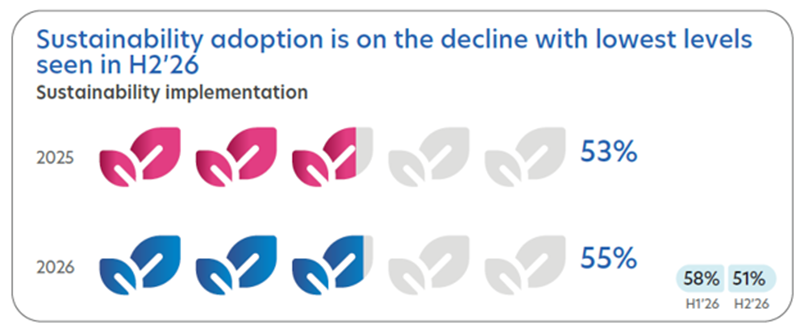
Sustainability adoption softened in H2, falling to 51% from 58% in H1, even as businesses continue to regard it as important.
Businesses increasingly view sustainability as a way to build an environmentally and socially sustainable future and contribute to the wider ecosystem, rather than focusing primarily on reputation or the ease of working with multinational corporations.
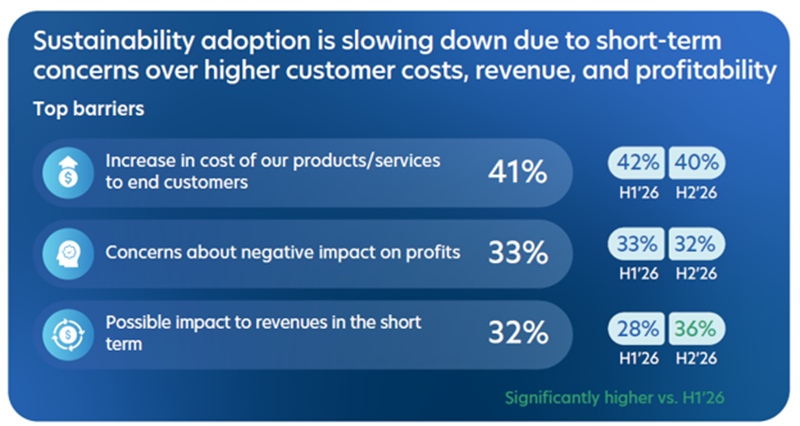
Near-term commercial pressures remain the main constraint. Concerns include higher costs for end customers (41%), reduced profits (33%) and potential short-term revenue impacts (32%). The pullback reflects these commercial pressures rather than inadequate renewable-energy infrastructure or financial support.
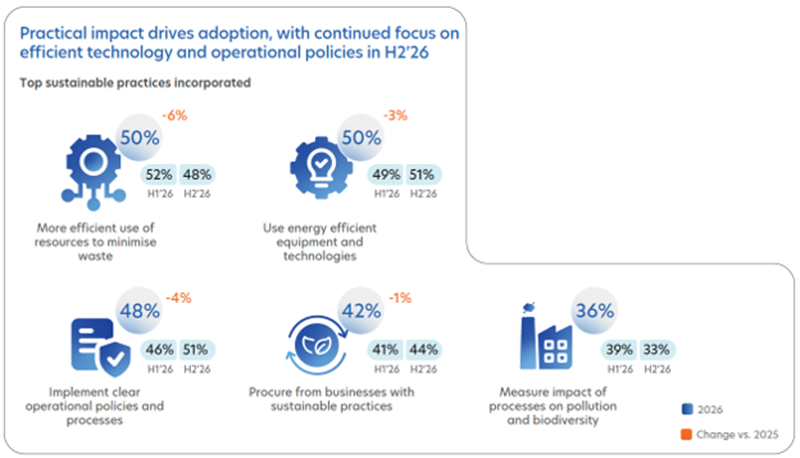
Among businesses implementing sustainability practices, efficient resource utilisation and energy-efficient technologies are the leading actions, both cited by 50%. These measures can help align sustainability objectives with tangible operational priorities.
Energy-price volatility has had a more contained impact on businesses in China, with 30% very or extremely concerned, compared with the regional average of 58%. Nevertheless, 92% consider energy management and efficiency important in H2, up from 89% in H1.

Four in five businesses are taking active measures to address energy disruption, including diversifying energy sources, improving efficiency and expanding energy-storage capacity. To mitigate energy-price shocks, 49% are improving energy efficiency, while 37% are signing long-term renewable-energy power purchase agreements. Businesses are also diversifying their fuel and energy mix.
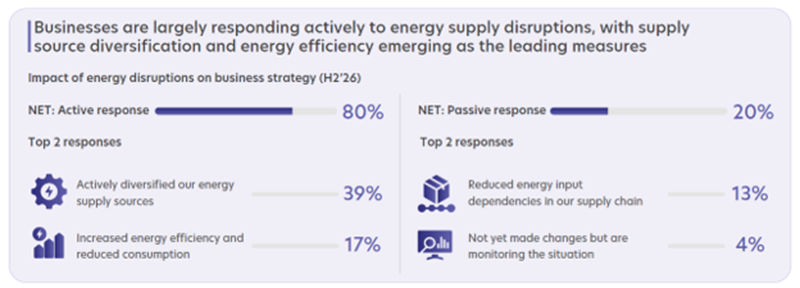
These findings point to the continued importance of managing energy costs and strengthening resilience, even where immediate concern about price volatility is comparatively low.
China businesses enter the second half of 2026 with stronger sentiment, but their priorities remain grounded in practical needs: improving productivity, managing costs and building resilience amid uneven growth and geopolitical uncertainty.
Targeted digital and AI investment, trusted partnerships and overseas expansion offer avenues for growth, while supply-chain and energy management remain central to managing risk. Businesses will need to balance these opportunities with the capabilities, financing and relationships required to turn their plans into results.
At UOB, we support businesses with the financing, ASEAN networks and transaction banking solutions they need to digitalise, expand and build resilience across the region. Contact us to find out more.


14 Sep 2026 • 6 MINS READ

Get the UOB Business Outlook Study 2026 (China) H2. Download now.