You are now reading:
ASEAN Consumer Sentiment Study 2026 (Singapore): How Singaporeans are building financial resilience
Find out how we can help you fast-track your investments in the JS-SEZ.
Learn more
you are in UOB ASEAN Insights


You are now reading:
ASEAN Consumer Sentiment Study 2026 (Singapore): How Singaporeans are building financial resilience
Singaporeans continue to feel the squeeze as rising inflation and economic uncertainty are the primary concerns keeping consumers up at night.
Despite mounting cost pressures, Singaporeans remain confident managing their personal finances. The UOB ASEAN Consumer Sentiment Study 2026 found that savings discipline strengthened, with three in four Singaporeans saving over 10 per cent of their monthly income. Nearly all (93 per cent) reported having an emergency fund and 86 per cent felt confident in their ability to manage their personal finances effectively—eight percentage points higher than the previous year.
Now in its seventh edition, the study surveyed 5,000 consumers aged 18 to 65 across Singapore, Malaysia, Thailand, Indonesia and Vietnam in June 2026. The findings show that Singaporean consumers are more financially literate and prepared for uncertainty compared to recent years.
While Singaporeans are exposed to uncertainty and risk, many are proactively building financial resilience through larger emergency funds and consistent investment discipline.
For Singaporean, wealth extends beyond asset accumulation and is more closely associated with quality of life and peace of mind. The top three associations of being wealthy are freedom from financial worries (44 per cent), good health and physical wellbeing (39 per cent) and being able to afford meaningful experiences like travel, dining and personal development (36 per cent).
Wealth is openly discussed in Singapore, mostly within trusted personal networks—particularly among spouses, parents and close friends. However, the majority of Singaporeans make their own decisions when it comes to investments. Only 16 per cent get input from their partner or family, while only 14 per cent cite investments as a joint decision with their partner or family. Meanwhile, 36 per cent engage financial advisors for their financial needs.
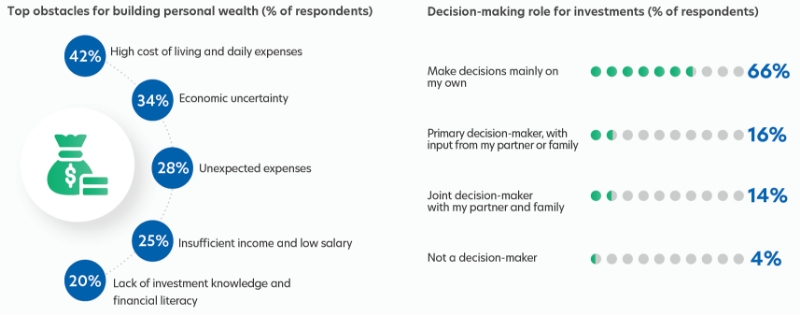
Cost pressures and economic uncertainty are the leading barriers to building wealth. The top three obstructions are high cost of living and daily expenses (42 per cent), economic uncertainty (34 per cent) and unexpected expenses (28 per cent).
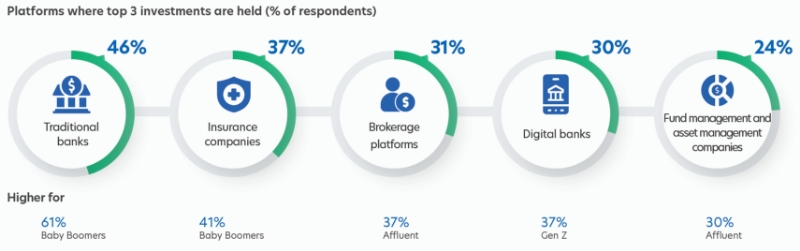
Traditional banks remain the leading platform for holding investments among Singaporeans.
Nearly half (46%) hold investments with traditional banks, ahead of insurance companies (37%) and brokerage platforms (31%).
Meanwhile, digital tools are becoming mainstream, with 90 per cent of Singaporeans using digital tools for wealth management. They mainly use these tools to gain visibility into their finances and get insights into their financial situation.
When it comes to their expectations of these digital tools, Singaporeans value simplicity and ease of use (36 per cent), strong security and privacy protection (35 per cent) and low fees (30 per cent).
Despite high usage of digital tools, only 6 per cent of Singaporeans believe they can fully rely on digital tools all the time. Most still value the guidance of a relationship manager and do not see digital tools as a complete substitute. They will turn to a human relationship manager, especially if they need guidance on complex products, investment decisions and financial fees or charges.
Information abounds in the age of AI and technology, but many Singaporeans still believe that primary banks (76 per cent), a peer, friend or family member (72 per cent) and a human financial advisor or wealth manager (70 per cent) will act in their best financial interest. This is higher than the 57 per cent who believe AI-powered tools will do the same.
Consumers use AI mostly to understand financial information (36 per cent) and compare banking products (33 per cent). Some use AI to make investments (31 per cent) or budgeting, spending and savings decisions (29 per cent). Others use AI as a precursor to speaking to a human financial advisor, like asking it to prepare questions (22 per cent).
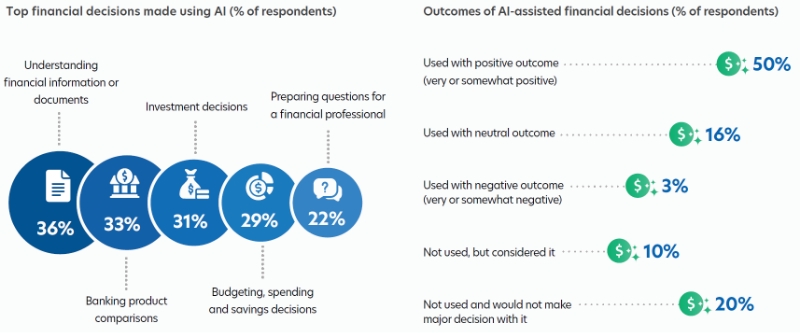
Half of Singaporeans had a positive outcome from their AI-assisted financial decisions, but 20 per cent are opposed to AI’s role in their financial decision-making and would not use or make decisions with it.
Singaporeans are more confident about their personal finances now compared with the previous year. They are also more financially prepared, with 93 per cent stating they have an emergency fund. Of which, 68 per cent say they can cover three to six months of regular expenses—higher than the regional average of 61 per cent.
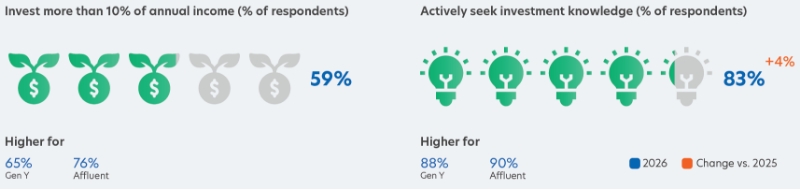
Three in four consumers invest over 10 per cent of their annual income, led by the Affluent and Gen Z. Gen Y and Affluent show a higher inclination toward enhancing their investment knowledge, higher than the average of 83 per cent across the board.
Most consumers (70 per cent) also believe they have at least a fair idea of the amount of money they need for a comfortable retirement, and two in three have acted on legacy planning, led by CPF nominations.
Singapore may be feeling the pressure, but our findings point to a consumer base that is far from financially passive. More Singaporeans are taking hold of their financial wealth by strengthening their savings and building wealth through investment.
For financial institutions, there is an opportunity to empower them further with personalised, trusted advisories as well as the digital tools for financial services they need to navigate financial decisions now and in the future.
To learn more about Singapore consumer sentiment, download the full UOB ASEAN Consumer Sentiment Study 2026 (Singapore) report here.
At UOB, we help businesses navigate the dynamic landscape of the ASEAN region to unlock their full potential. Contact us to find out about our tailored solutions, industry knowledge, and market expertise.

The ASEAN Consumer Sentiment Study (ACSS) is UOB’s flagship regional survey, tracking consumer trends and sentiment across five key markets: Singapore, Malaysia, Thailand, Indonesia and Vietnam. Now in its seventh year, the 2026 edition of the study was conducted in June and captures the views of 5,000 consumers, with 1,000 respondents from each country.
Key topics covered include: