You are now reading:
UOB Business Outlook Study 2026 (China) H1: Enterprises prioritise resilience, digitalisation and ASEAN growth

Find out how we can help you fast-track your investments in the JS-SEZ.
Learn more
you are in UOB ASEAN Insights


You are now reading:
UOB Business Outlook Study 2026 (China) H1: Enterprises prioritise resilience, digitalisation and ASEAN growth
Chinese Medium and Large Enterprises have adapted their growth playbook. In 2026, their top priority is building the capabilities to withstand a volatile environment while seizing its opportunities. Business transformation (45 per cent), operational efficiency (37 per cent), and digital infrastructure support (34 per cent) are the top areas where businesses seek support to drive success in 2026 and beyond.
Business sentiment has recovered to 78 per cent positive following the United States (US) tariff disruption, but the outlook for 2026 still falls 20 percentage points below 2022 levels. The challenging macro environment remains, shaped by uneven global recovery and high operating and manpower costs.
The UOB Business Outlook Study 2026 reveals that:
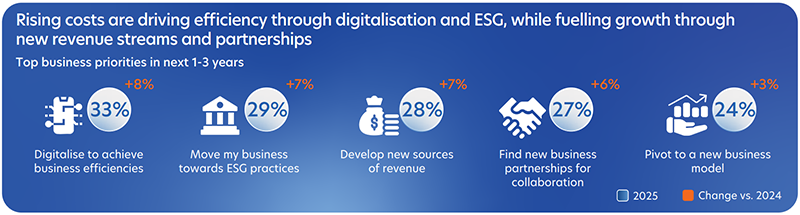
Digital transformation is nearly universal. Nearly nine in 10 businesses are digitalising at least one department. But as digitalisation matures, sustaining meaningful progress has become harder. Only 43 per cent of businesses report successful digitalisation, a decline of 13 percentage points since 2023.
The gap between enterprise sizes is sharpening. Only 35 per cent of Medium Enterprises report success in digitalisation, compared to 57 per cent of Large Enterprises.
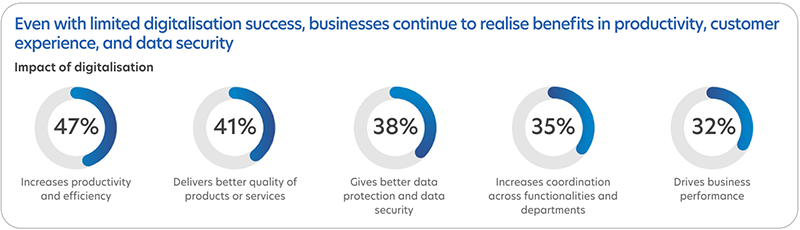
The returns where digitalisation succeeds are well established: productivity gains (47 per cent), improved product quality (41 per cent), and better data security (38 per cent).
Talent shortages (40 per cent), implementation costs (39 per cent), and cybersecurity concerns (33 per cent) continue to constrain digitalisation outcomes. Despite these challenges, commitment to investment remains firm. The majority (72 per cent) of businesses plan to increase digital spending in 2026.
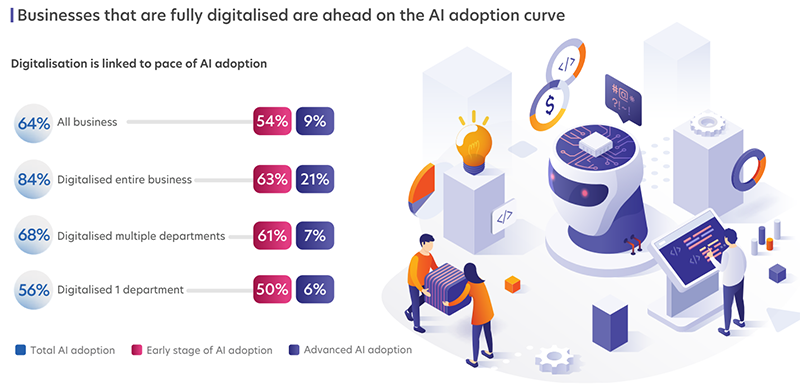
More than 60 per cent of businesses have adopted AI technologies, though most are still in early stages. Large Enterprises are adopting advanced AI at nearly three times the rate of Medium Enterprises.
Deployment is concentrated where returns are most visible. AI delivers operational value through productivity gains (56 per cent), cost reduction (47 per cent), and improved customer satisfaction and engagement (44 per cent).
Digital maturity is closely linked to the pace of AI adoption. Businesses that have digitalised their entire business (84 per cent) lead in advanced AI adoption.
The study reveals that AI is seen as a long-term competitive advantage. Ninety per cent of businesses intend to increase their AI budget, with over two in five businesses planning to increase it by more than 25 per cent in 2026.
Sustainability's importance rating has fallen to 87 per cent in 2025, down from 94 per cent in 2023. Adoption, however, has continued to rise. Changing motivation explains it. Businesses no longer prioritise sustainability for branding or MNC partnerships. Regulatory compliance and ecosystem participation are now playing an increasingly important role.
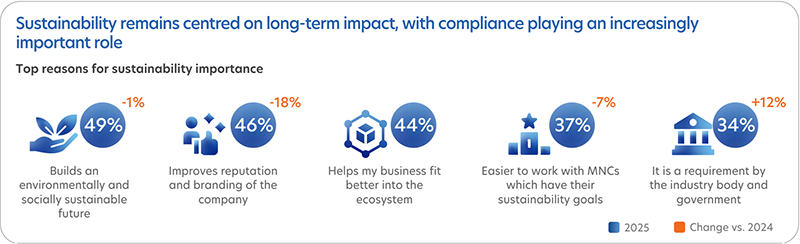
In response, business practices have become more operationally grounded, involving waste minimisation (52 per cent), energy-efficient equipment (49 per cent), and clear sustainability policies (46 per cent).
Higher costs (42 per cent), profit impact concerns (33 per cent) and gaps in renewable energy infrastructure (32 per cent) are key barriers to adoption. These pressures are particularly high in the Tech, Media & Telecom sector, where nearly one in two businesses face heightened challenges as rising customer costs weigh on profitability.
Energy management has moved from an environmental concern to an operational one. Almost nine in 10 businesses consider energy management and efficiency important, with Consumer Goods & Wholesale Trade showing the highest levels of prioritisation.
The primary focus is on reducing energy consumption (53 per cent), optimising energy use through digital tools (48 per cent), and lowering energy costs (42 per cent). About one in three businesses use energy management systems, HVAC upgrades, and efficient machinery as solutions.
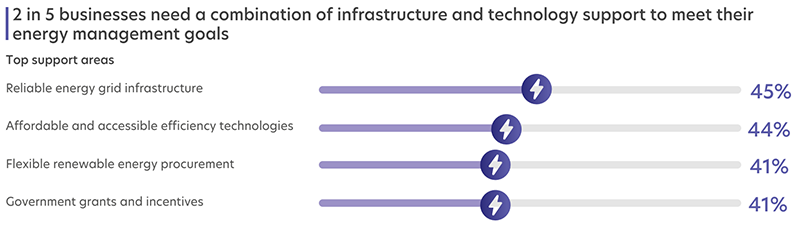
Businesses still face challenges in implementation: high upfront investment costs (46 per cent) and uncertain return on investment (36 per cent), particularly in cities with smaller economies and less developed infrastructure.
Geopolitical pressure on supply chains has decreased from its 2022 peak, with 47 per cent of businesses still reporting ongoing effects. Around one in three face active challenges in procurement, supply disruptions, and inventory management.
Regulatory uncertainty complicates supply chain planning the most. Ninety-one per cent of businesses report uncertainty around 'Local Content' and 'Country of Origin' rules. Over a third face ambiguity due to differing definitions of substantial transformation, weak trade pact harmonisation, and limited supply chain transparency.
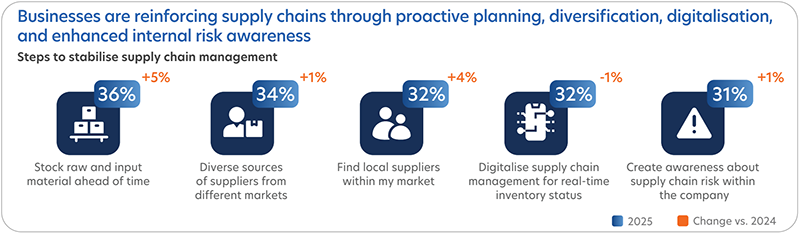
In response, six in 10 businesses plan to expand their supplier base in 2026. One in two is setting up new manufacturing bases, primarily in ASEAN or domestically in China, reflecting China+1 strategies. Expansion is driven by resilience (59 per cent), cost optimisation (56 per cent), and access to new markets (56 per cent).
Fifty-six per cent of Chinese businesses expanded overseas in 2025. ASEAN was the primary destination, followed by Hong Kong SAR and Europe. Interest in future overseas expansion remains strong at 80 per cent. Businesses are increasingly expanding overseas to capture market opportunities, up nine points from 2024, rather than simply pursuing profits or revenue growth.
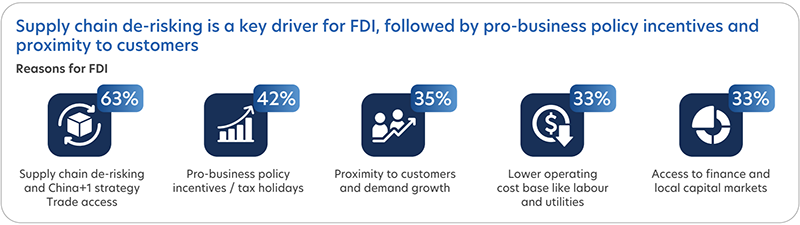
About two in three businesses plan foreign direct investment (FDI) in the next two years, targeting ASEAN (45 per cent), followed by Hong Kong SAR. Malaysia (56 per cent), Singapore (54 per cent), and Thailand (51 per cent) are the priority markets in the region. Supply-chain de-risking and China+1 strategies are the leading FDI motivation, alongside pro-business incentives and customer proximity.
Chinese businesses are treating resilience as a growth strategy. Digitalisation, AI adoption, energy efficiency, supply chain transformation, and regional expansion enable businesses to compete in an unpredictable environment.
The maturity gap between Large and Medium Enterprises is noticeable in this landscape. Large Enterprises are moving faster, investing more, and capturing returns sooner. The opportunity for Medium Enterprises lies in closing that gap through strategic partnerships, targeted technology investments, and access to the right advisory expertise.
At UOB, we support businesses with the financing, ASEAN networks, and transaction banking solutions they need to digitalise, expand, and build resilience across the region. Contact us to find out more.

The UOB Business Outlook Study 2026 (China) H1 surveyed 380 business owners and senior executives from Medium and Large Enterprises in China. Conducted online in January 2026, the study offers insights into:
The H1 2026 edition also introduces three new Pulse Topics, offering deeper insights into emerging business priorities:
This article shall not be copied or relied upon by any person for whatever purpose. This article is given on a general basis without obligation and is strictly for information only. The information contained in this article is based on certain assumptions, information and conditions available as at the date of the article and may be subject to change at any time without notice. You should consult your own professional advisers about the issues discussed in this article. Nothing in this article constitutes accounting, legal, regulatory, tax or other advice. This article is not intended as an offer, recommendation, solicitation, or advice to purchase or sell any investment product, securities or instruments. Although reasonable care has been taken to ensure the accuracy and objectivity of the information contained in this article, UOB and its employees make no representation or warranty, whether express or implied, as to its accuracy, completeness and objectivity and accept no responsibility or liability for any error, inaccuracy, omission or any consequence or any loss or damage howsoever suffered by any person arising from any reliance on the views expressed and the information in this article.


24 Jul 2026 • 3 mins read