You are now reading:
UOB Business Outlook Study 2026 (Hong Kong) H2: Businesses Navigate Challenging Environment But are Optimistic About the Future

Find out how we can help you fast-track your investments in the JS-SEZ.
Learn more
you are in UOB ASEAN Insights


You are now reading:
UOB Business Outlook Study 2026 (Hong Kong) H2: Businesses Navigate Challenging Environment But are Optimistic About the Future
Hong Kong businesses are navigating a challenging operating environment, with rising costs and geopolitical uncertainty weighing on business confidence. While overall sentiment remains subdued, companies are continuing to invest in digitalisation and artificial intelligence (AI), strengthen supply-chain resilience, and explore overseas opportunities, particularly across Mainland China and ASEAN.
These are among the findings of the UOB Business Outlook Study 2026 (Hong Kong) H2, which examines the business sentiment, priorities, and strategies of Hong Kong’s Medium and Large Enterprises amid evolving economic and geopolitical conditions. The findings point to a business landscape where companies are becoming more cautious about near-term performance but remain committed to strengthening their capabilities and pursuing longer-term growth opportunities. Some of the key findings include:
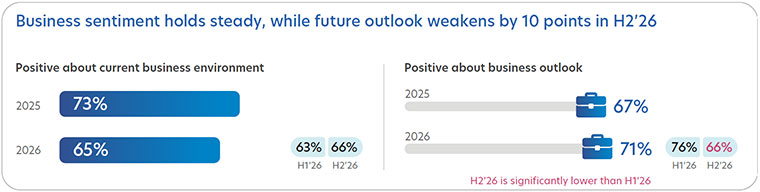
Business sentiment in Hong Kong improved slightly in H2 2026, with 65 per cent of businesses feeling positive about the current business environment, up from 63 per cent in H1 but still below the 73 per cent recorded in 2025. Businesses in Professional Services, Healthcare & Medical Services, and Real Estate & Hospitality reported more positive sentiments, while those in Tech, Media & Telecom, Construction & Infrastructure, and Wholesale Trade reported the most pessimism.
Rising operating costs, along with geopolitical tensions brought about by US tariffs and the ongoing US-Iran conflict, are behind the dampened sentiments. Two in five businesses (42 per cent) reported moderate to severe disruptions from the US-Iran conflict, with those in Manufacturing & Engineering (61 per cent) and Large Enterprises (48 per cent) experiencing more disruptions. Nearly all businesses (91 per cent) reported experiencing higher costs ranging from below 15 per cent to over 30 per cent due to the conflict.
Businesses are responding by diversifying or nearshoring supply chains away from the Gulf region (41 per cent) and accelerating cybersecurity and digital-infrastructure resilience (39 per cent). Meanwhile, 34 per cent are relocating or reconsidering regional headquarters or operations.
Geopolitical events are also impacting supply chains, though to a lesser degree compared with H1. Half of respondents (50 per cent) said they were highly affected by the conflicts, compared with 60 per cent in H1. Still, businesses are supporting operational resilience through alternative raw materials, supplier diversification, and digitalisation of supply chain management.
Most businesses with weaker current sentiments have higher hopes for the future, with 59 per cent expecting recovery by 2028 or later. But the outlook across all businesses has softened considerably — only 66 per cent expecting business performance to improve in H2 versus 76 per cent in H1. Large Enterprises remain considerably more optimistic than Medium Enterprises.
Digital transformation continues to be a priority for Hong Kong businesses, with companies increasingly recognising its value in improving operational performance and customer engagement.
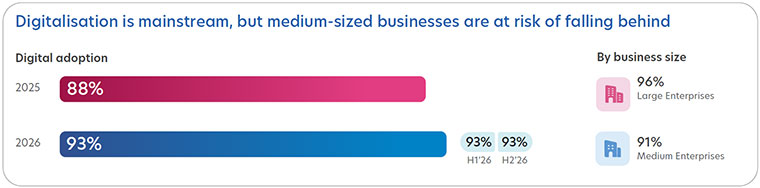
For full-year 2026, productivity and efficiency gains are the leading benefits of digitalisation (37 per cent), followed by improved customer experience (30 per cent). However, translating digital adoption into tangible business outcomes remains a challenge. Digitalisation success stood at 58 per cent in H2. The full-year findings also reveal a 13-percentage-point gap between Large and Medium Enterprises, with the latter lagging. This suggests a need for digital solutions customised to the requirements of smaller businesses. Meanwhile, implementation costs, cybersecurity, and skills remain important constraints, especially for Large Enterprises.
Nevertheless, investment intentions remain strong — 75 per cent expect to increase their spending on digital solutions in H2. Blockchain and distributed ledger technology (DLT) are also gaining traction, with 58 per cent of businesses piloting or planning adoption.
AI adoption has accelerated sharply, rising to 88 per cent in H2 from 57 per cent in H1. The proportion of businesses at advanced stages of adoption has also more than tripled, from 12 per cent to 37 per cent, indicating a significant shift towards more extensive integration of AI into business operations.
Businesses see the greatest value in using AI for operations and process automation (58 per cent), followed by product and service innovation (53 per cent) and customer service and support (51 per cent).
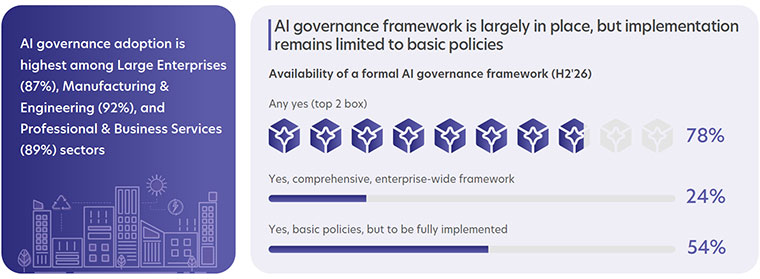
As adoption advances, businesses are recognising the need for appropriate governance and workforce planning. Some 78 per cent have established some form of AI governance framework, although most remain at a basic policy level and have yet to be fully implemented. Large Enterprises are generally further ahead than Medium Enterprises in establishing governance structures.
Businesses are also taking a human-centred approach to AI transformation, with 60 per cent prioritising job redesign, compared with 17 per cent focusing on reskilling and 12 per cent on external AI hiring. This suggests that companies are looking to integrate AI into existing workflows and reshape roles, rather than relying primarily on new recruitment.
Agentic AI is another emerging area, with 45 per cent of businesses having deployed multi-agent systems or actively piloting or planning their adoption. Meanwhile, 90 per cent expect their AI budgets to increase by at least 25 per cent. These sentiments signal confidence in AI’s potential to support productivity and business growth.
While Hong Kong businesses remain predominantly domestically oriented, external partnerships and overseas expansion continue to offer important avenues for growth.
Some 77 per cent of businesses operate primarily within the domestic market, and 68 per cent generate most of their revenue from domestic customers. Cross-border operations are more prevalent among businesses in Tech, Media & Telecom, and Large Enterprises.
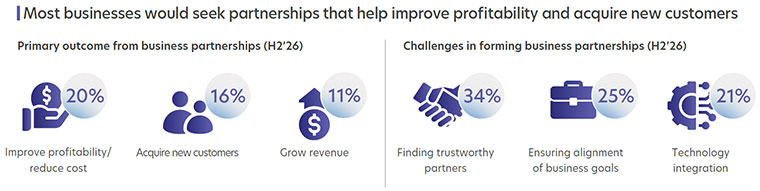
Still, 70 per cent of businesses recognise external partnerships as important to growth. Supply-chain and sourcing partnerships are the most relevant (30 per cent), followed by cross-border and international partnerships (27 per cent), and industry partnerships (27 per cent).
These relationships are primarily driven by near-term commercial objectives, particularly improving profitability and reducing costs, as well as acquiring new customers. However, finding trustworthy partners remains the leading challenge, followed by aligning business goals and integrating technology.
Overseas expansion activity has moderated, with 49 per cent of businesses having expanded overseas in 2026, down from 57 per cent in 2025. However, future expansion appetite remains strong, with 79 per cent expressing interest in entering overseas markets.
Mainland China remains the leading destination, with interest rising significantly to 44 per cent in H2 from 26 per cent in H1. ASEAN is another important growth region, attracting interest from 40 per cent of businesses. Within ASEAN, Singapore, Malaysia, and Vietnam are the leading destinations, with interest in Singapore increasing compared with 2025 and interest in Malaysia strengthening in H2.
Revenue growth is the primary motivation for overseas expansion. However, finding the right partners remains a key barrier, highlighting the importance of market knowledge and trusted business networks in supporting cross-border growth.
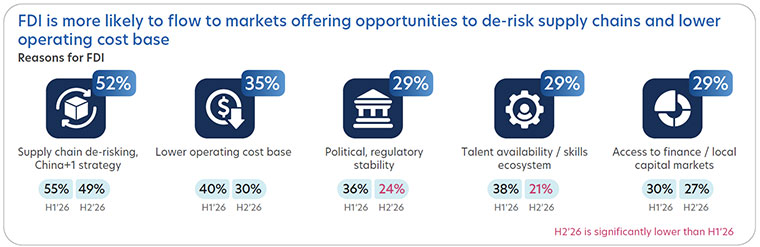
Investment intentions are similarly encouraging. Some 67 per cent of businesses are likely to make foreign direct investments (FDI) over the next 12 to 24 months, with Mainland China attracting the largest share of intended investments, followed by ASEAN. Businesses are primarily motivated by supply-chain de-risking and China+1 strategies (52 per cent), as well as opportunities to lower operating costs (35 per cent). The average planned FDI stands at approximately US$14.8 million.
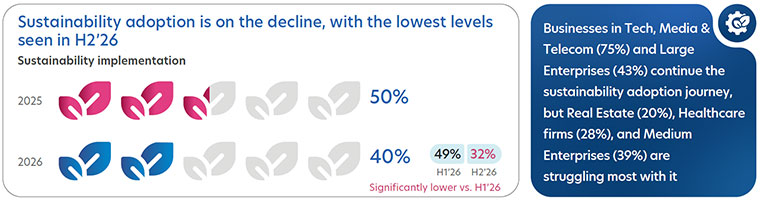
Sustainability adoption has weakened in H2. The proportion of businesses implementing sustainability practices fell to 32 per cent from 49 per cent in H1, though the overall importance attached to sustainability has remained relatively stable. Many view it as a means to gain a competitive advantage and contribute to a more environmentally and socially sustainable future.
However, financial and commercial considerations continue to constrain implementation. Inadequate financial support is the leading barrier (29 per cent), followed by concerns about potential short-term revenue impact (28 per cent) and higher costs to customers (28 per cent).
Consequently, businesses are focusing on practical measures that can deliver clearer operational benefits. Efficient resource utilisation is the leading sustainability action (42 per cent), followed by energy-efficient technologies (39 per cent).
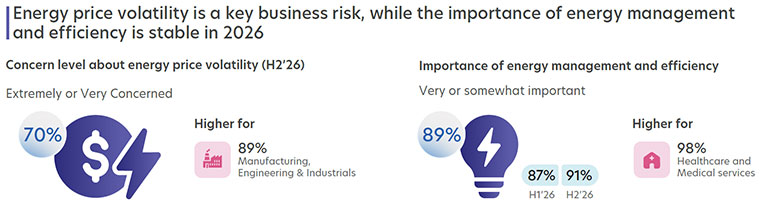
Energy management is particularly important amid ongoing geopolitical uncertainty and energy-price volatility. Some 70 per cent of businesses are very or extremely concerned about fluctuations in energy prices, while 91 per cent regard energy management and efficiency as important in H2.
Businesses are taking active steps to address energy-supply disruptions, with 78 per cent implementing measures such as diversifying energy sources, investing in energy storage, and improving energy efficiency. However, high upfront investment costs (37 per cent) and uncertain returns on investment (33 per cent) remain significant obstacles to longer-term energy-management investments.
The UOB Business Outlook Study 2026 (Hong Kong) H2 highlights a business environment in which confidence remains subdued amid rising operating costs and geopolitical uncertainty. However, businesses are continuing to invest in the capabilities needed to navigate these challenges and capture new opportunities.
Digitalisation and AI adoption are accelerating, while supply-chain management remains a priority as companies seek to diversify their operations and strengthen resilience. At the same time, interest in overseas expansion remains strong, with Mainland China and ASEAN continuing to attract businesses looking for new markets and investment opportunities.
With its regional connectivity, financial expertise, and cross-border capabilities, UOB is committed to supporting businesses as they navigate market uncertainties, strengthen their operations, and pursue growth opportunities across Asia. Contact us to find out how UOB can support your business.

The UOB Business Outlook Study 2026 (Hong Kong) surveyed a total of 505 business owners and senior executives from Medium and Large Enterprises in Hong Kong. Conducted online in January 2026 (H1) and August to September 2026 (H2) the study offers insights into:
The 2026 H1 and H2 editions also introduces three new Pulse Topics, offering deeper insights into emerging business priorities:
This article shall not be copied or relied upon by any person for whatever purpose. This article is given on a general basis without obligation and is strictly for information only. The information contained in this article is based on certain assumptions, information and conditions available as at the date of the article and may be subject to change at any time without notice. You should consult your own professional advisers about the issues discussed in this article. Nothing in this article constitutes accounting, legal, regulatory, tax or other advice. This article is not intended as an offer, recommendation, solicitation, or advice to purchase or sell any investment product, securities or instruments. Although reasonable care has been taken to ensure the accuracy and objectivity of the information contained in this article, UOB and its employees make no representation or warranty, whether express or implied, as to its accuracy, completeness and objectivity and accept no responsibility or liability for any error, inaccuracy, omission or any consequence or any loss or damage howsoever suffered by any person arising from any reliance on the views expressed and the information in this article.
Get the UOB Business Outlook Study 2026 (Hong Kong) H2.Download now