You are now reading:
ASEAN Conference 2026: ASEAN’s Future in a Fractured World
Find out how we can help you fast-track your investments in the JS-SEZ.
Learn more
you are in UOB ASEAN Insights
You are now reading:
ASEAN Conference 2026: ASEAN’s Future in a Fractured World
ASEAN attracted a record US$244 billion in foreign direct investment (FDI) in 2025. At the ASEAN Conference 2026, business leaders shared that deeper integration, bolstered by public-private partnerships, can help businesses turn the region’s inherent diversity into resilient economic growth.
In a period when trade, capital, people and technology flows are constantly being redrawn, deeper ASEAN integration is reducing friction of doing business in the region.
For companies considering expanding in ASEAN, the opportunity lies in building connected operations across complementary markets, rather than treating each country as a standalone investment.
FDI into ASEAN has more than doubled from US$115 billion in 2015 to a record US$244 billion in 2025. Over the same decade, the region’s share of global FDI rose from 5 per cent to 15 per cent.
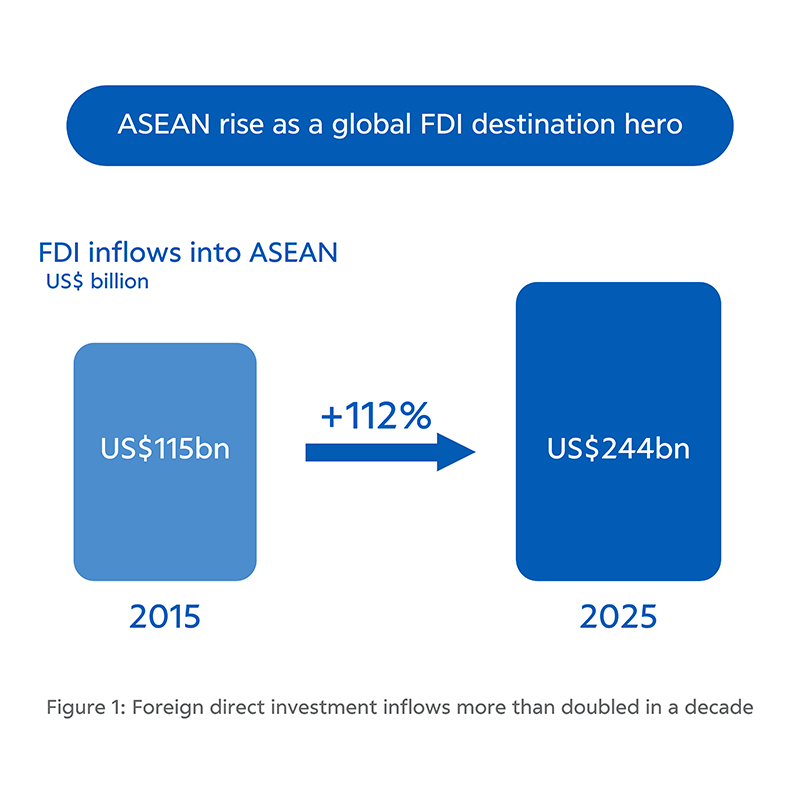
The continued growth points to more than a short-term capital re-allocation. Global companies are not merely looking at ASEAN as a consumer market; they are building supply chains, innovation capabilities and cross-border operations throughout the region.
“ASEAN is no longer reacting to the future. We are shaping it.”
Frederick Chin, Head of Group Wholesale Banking and Markets, UOB
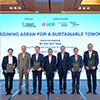
That conviction framed the 10th ASEAN conference, held at Resorts World Convention Centre in Singapore on 30 and 31 July 2026.
The landmark two-day edition of this year’s event welcomed more than 1,600 business, government and industry leaders from over 20 markets to explore “ASEAN’s Future in a Fractured World”.
ASEAN combines a large consumer base, diverse production capabilities and growing digital demand with an expanding network of trade and investment links.
ASEAN turns its diversity into a competitive advantage by enabling companies to spread operations across markets with complementary capabilities. Its location also connects major trade flows between China, South Asia and the wider Asia-Pacific region.
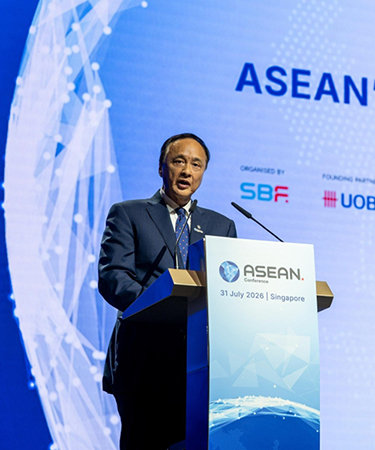
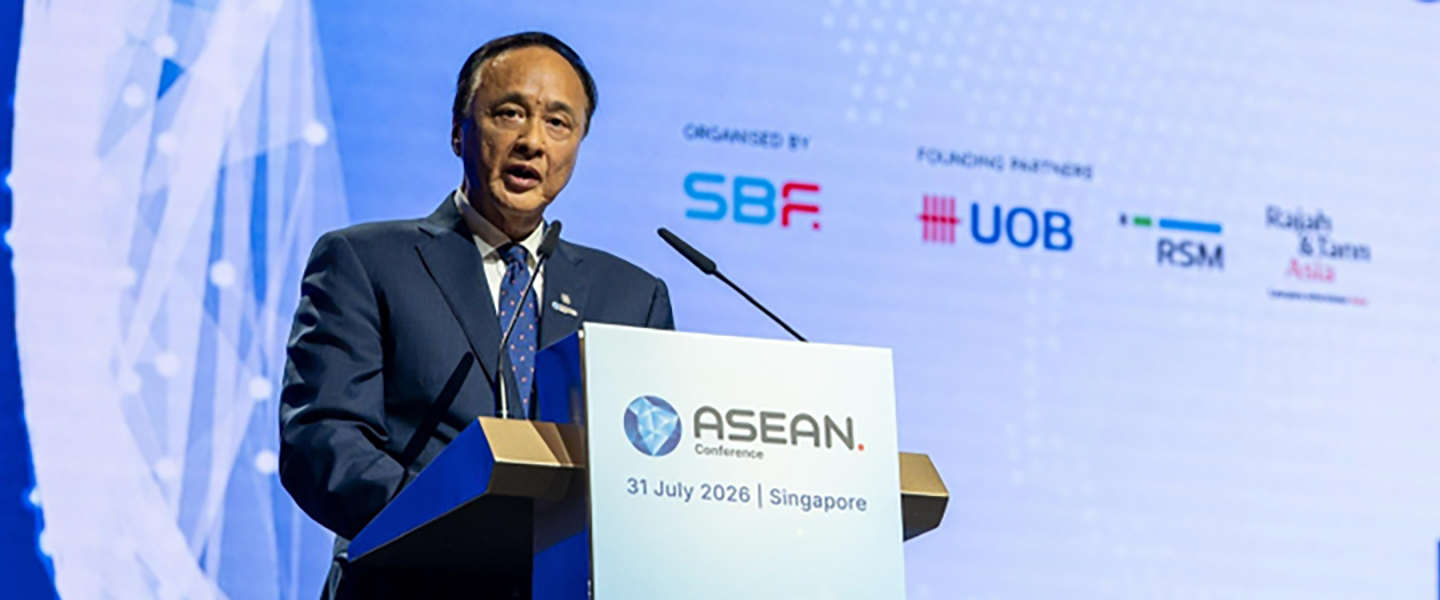
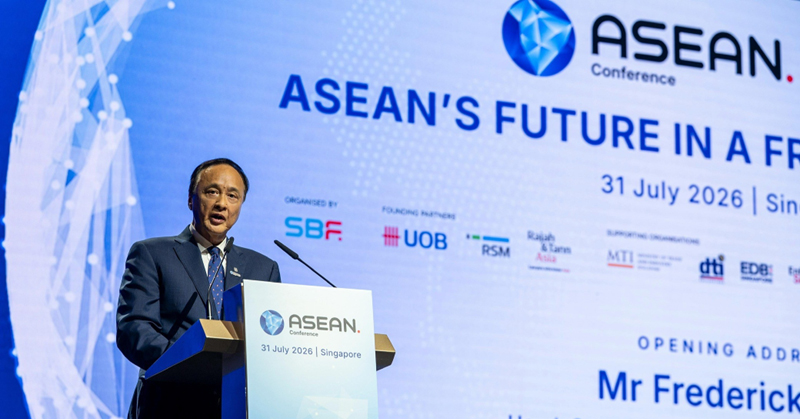
In his opening address, Frederick Chin, Head of Group Wholesale Banking and Markets at UOB described ASEAN as a strategic centre of gravity as global trade corridors and capital allocation shift in response to a world in flux.
“A fractured world does not weaken ASEAN. It creates the space for ASEAN to lead.”
Frederick Chin, Head of Group Wholesale Banking and Markets, UOB
The first day of the conference, the ASEANext Forum, brought together the next generation of business leaders, entrepreneurs, investors and changemakers to discuss leadership, innovation and investment.
At the Forum, Angela Koh, Head of Wealth Planning and Family Advisory Services, UOB Private Bank, urged successors to see themselves as more than beneficiaries.
Koh shared that next generation of leaders inherit not just growing enterprises, but also the responsibility to strengthen trust, connections, and institutions that underpin ASEAN’s progress.
“You’re not just inheriting assets, you’re custodians: the financial capital, the social capital that the family has developed and grown.”
Angela Koh, Head of Wealth Planning and Family Advisory Services, UOB Private Bank
On the second day, discussions turned to “ASEAN’s Future in a Fractured World”.
In the ministerial dialogue, Singapore’s Deputy Prime Minister (DPM) and Minister for Trade and Industry (Trade) Gan Kim Yong shared that ASEAN’s response to a fractured world has been greater integration.
“The world is fracturing, fragmenting apart, but at the same time, ASEAN is integrating.”
Gan Kim Yong, Singapore Deputy Prime Minister and Minister for Trade and Industry (Trade)
During the dialogue, DPM Gan explained that ASEAN’s ability to integrate rests on trust accumulated through overcoming past crises together. This trust allows ASEAN members with different strengths and development stages to keep advancing shared rules and infrastructure.
For example, the ASEAN Digital Economy Framework Agreement (DEFA), makes it easier for companies – particularly small and medium-sized ones – to scale across Southeast Asia. Expected to take effect in 2027, DEFA promotes more consistent rules for digital trade, data flows, payments and online transactions to facilitate cross-border transactions.
“DEFA is designed to make digital trade easier, safer, and more seamless across our borders.”
Ma. Cristina A. Roque, Secretary of Trade and Industry of the Philippines
Roque described DEFA as a regional framework spanning cross-border e-commerce, digital payments, digital identity, cyber security, data governance and digital talent.
Regional artificial intelligence (AI) frameworks, the ASEAN Power Grid and green economy agreements could deepen that integration further.
The next step is execution: businesses will need to translate these initiatives into commercially viable investments, infrastructure and services.
As DPM Gan shared, the aim is to build “a more connected and seamless ASEAN market”.
An integrated digital infrastructure is central to making these initiatives a reality.
At the UOB Gateway to ASEAN Panel Showcase, UOB and Amazon Web Services (AWS) examined how investment in cloud and AI infrastructure can power ASEAN’s next growth phase.
AWS plans to invest more than US$33 billion in cloud and AI infrastructure across Indonesia, Malaysia, Singapore and Thailand by 2039. The investments are expected to support thousands of jobs annually and add US$64 billion to the four countries’ combined gross domestic product by 2039.
John Kain, who leads Worldwide Business and Market Development for Financial Services at Amazon Web Services (AWS) made a practical point: companies should begin adopting AI now, focusing on how it can improve productivity, efficiency and customer outcomes, rather than waiting for a perfect model.
Kain also shared that Amazon has trained more than 2.7 million people in the region on cloud skills since 2017.
ASEAN’s digital backbone will depend on cloud infrastructure, trusted data flows, energy capacity and skilled talent. These foundations will determine whether companies can use AI to build new regional capabilities instead of simply consuming digital services.
“AI is driving both economic growth and financing demand. To scale AI successfully, businesses need strong foundations and execution capabilities, while financial institutions are increasingly acting as strategic capital connectors, linking companies to diverse funding sources beyond traditional bank lending.”
Edmund Leong, Head of Group Corporate Banking and Sector Solutions Group, UOB
View the session here: Gateway to Asean 2026 | UOB Business
Digital integration becomes more realistic when companies can find the right location, partners and capabilities.
Strategic collaborations announced at the conference demonstrated how an ecosystem approach helps reduce friction and make cross-border investments more practical.
UOB and JTC Corporation signed a collaboration agreement to support companies setting up or expanding in Singapore, connecting them to industry ecosystems, capacity-building and enterprise transformation opportunities.
Taiwan-listed AI solutions and advanced electronics design manufacturer, FIC Global, Inc., for example has plans to establish facilities in JTC’s Woodlands industrial zone. This complements its manufacturing operation at AME’s industrial park in Johor, Malaysia, through its Malaysian subsidiary PRO3C.
By connecting the company with industrial park partners in Singapore and Malaysia, UOB helped strengthen the cross-border value chain within the Johor-Singapore Special Economic Zone (JS-SEZ). With this collaboration, UOB’s FDI Advisory went beyond financing to ecosystem access and market entry support.
Other collaborations announced at the conference, reinforce the viability of intra-regional integration. UOB Indonesia and Suryacipta signed a Memorandum of Understanding to facilitate investment into Indonesia, strengthening regional connectivity and supporting companies entering one of ASEAN’s largest markets.
As companies add entities, suppliers and customers across various geographies, financial complexity increases.
Treasury strategy becomes an important part of business resilience. A well-designed regional treasury centre can give growing companies better viability and control over liquidity, funding, and financial risk while supporting consistent governance across markets.
At the conference, founding conference partners RSM, UOB and Rajah & Tann Asia launched the latest edition of Building a Treasury Centre for Sustainable Growth.
The publication offers practical guidance on treasury centre strategy, jurisdictional comparisons, regulatory and tax development and the impact of Base Erosion and Profit Shifting (BEPS) 2.0 measures.
For mid-cap companies expanding into ASEAN, treasury design needs to be part of the market-entry strategy from the start – alongside location, supply chain, talent, and technology decisions.
The first step is not simply choosing a country.
While ASEAN’s diversity is a source of resilience, it also means that there is no single formula for expansion.
Businesses first need to identify connections required to build a viable regional model, including the right market-entry strategy, industrial ecosystem, supply- hain, talent, innovation capabilities and treasury structure.
Since 2011, UOB’s FDI Advisory has supported more than 5,500 companies on their internationalisation journeys. The bank’s advisory teams spread across the region have also facilitated more than S$55 billion in investments and helped create over 330,000 job opportunities.
Its one-stop platform combines market entry advice, access to ecosystem partners for supply-chain localisation, cross-border banking and treasury solutions through UOB’s ASEAN network.
“Trust will be ASEAN’s most valuable currency.”
Frederick Chin, Head of Group Wholesale Banking and Markets, UOB
ASEAN turns 60 in 2027, when Singapore assumes the ASEAN chairmanship. This milestone comes as the region works to deepen integration while remaining open to the world.
For business leaders, the opportunity is not limited to one market or one investment cycle.
It lies in building trusted connections across a region whose economies, capabilities and talent can deliver compound benefits.
“When ASEAN connects, ASEAN compounds.”
Frederick Chin, Head of Group Wholesale Banking and Markets, UOB


15 Jul 2026 • 6 mins read

18 Nov 2025 • 6 MINS READ

25 Aug 2025 • 6 MINS READ